
The Architecture of Money · Part 4
Hong Kong 1997–1998: When the Market Attacked the Hong Kong Dollar
A currency peg, a “double play,” and the ten days a government bought its own stock market.
In Part 3 we saw that money is a system of promises.
Hong Kong in 1997 shows what happens when the market decides to test one of those promises.
Head on.
With billions of dollars.
1. The Peg: a Promise Written in Dollars
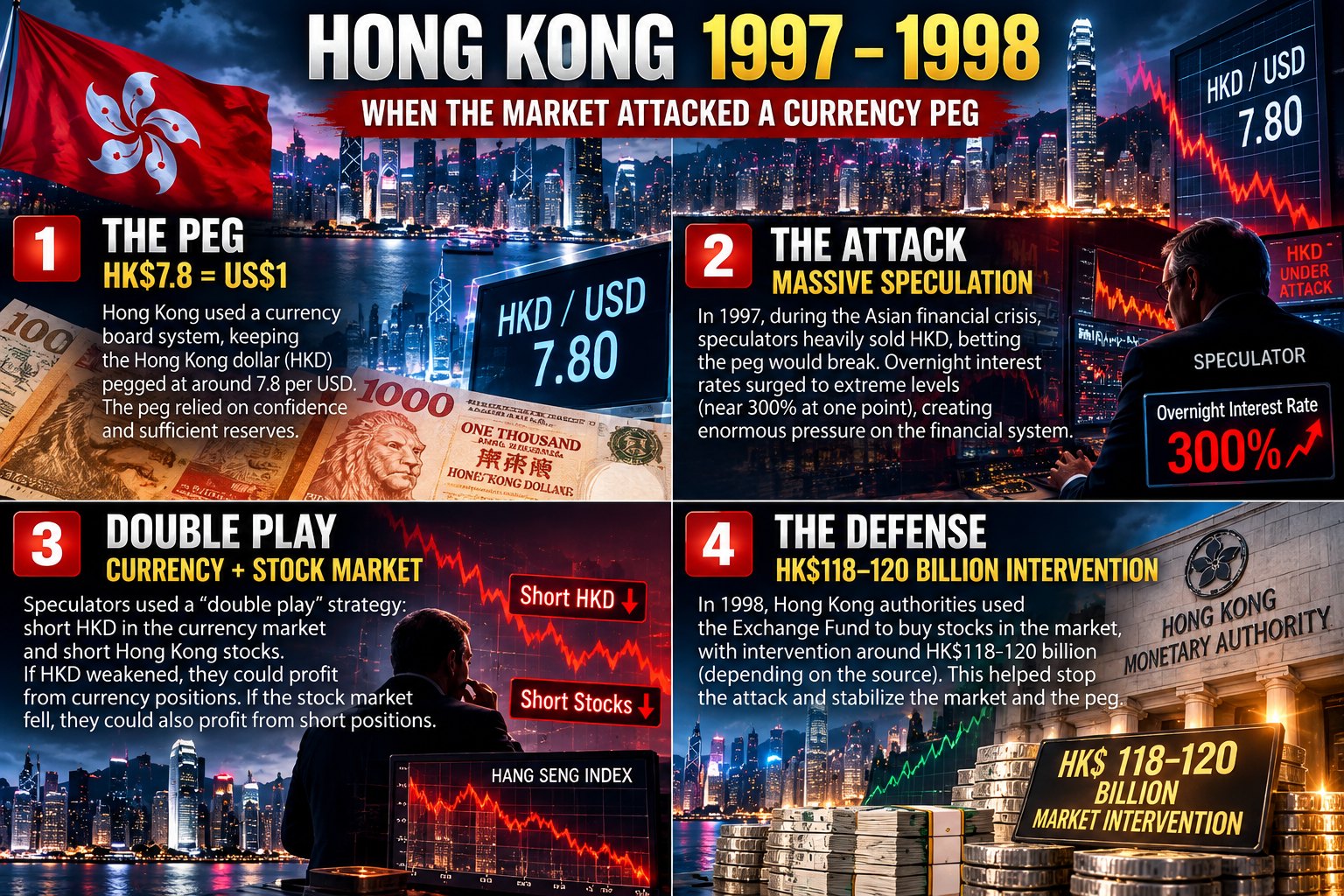
Since 17 October 1983, the Hong Kong dollar has been linked to the U.S. dollar at about HK$7.80 to US$1. The Hong Kong Monetary Authority (HKMA) calls this the Linked Exchange Rate System.
The rule is simple, and strict.
Hong Kong dollars in the base of the system are backed by U.S. dollars held in reserve. If people want to swap Hong Kong dollars for U.S. dollars, the system pays out at the fixed rate.
No printing your way out.
No sudden devaluation.
That strictness is the strength of a peg. It is also the target.
2. The Attack: October 1997
In 1997 the Asian financial crisis swept through the region. Currencies that had been tied to the dollar broke one after another.
Traders turned to Hong Kong and asked one question: will this peg break too?
They sold Hong Kong dollars in huge size.
Under a currency board, there is an automatic defense. When Hong Kong dollars are sold, the supply of Hong Kong dollars in the banking system shrinks. Money becomes scarce. And when money is scarce, its price rises.
The price of money is the interest rate.
On 23 October 1997, according to the Hong Kong Government’s own 1997 Yearbook, the overnight interbank interest rate briefly touched 280 per cent.
Not 2.8 per cent. Two hundred and eighty.
The peg held. But the stock market paid for it, because very high interest rates are poison for share prices.
3. The Double Play: Two Bets, One Trap
Some speculators noticed that link, and in 1998 they came back with a sharper plan. The HKMA itself later called it a “double play”.
It worked like this:
- Bet one: sell short the Hang Seng stock index, mainly through futures, so you profit if stocks fall.
- Bet two: sell large amounts of Hong Kong dollars.
If the peg broke, the currency bet paid.
If the peg held, the automatic defense would push interest rates up, stocks would fall, and the index bet paid.
Either way, the speculators expected to win. The defense of the currency was being used as a weapon against the stock market.
According to the HKMA, the attackers were aiming to push the Hang Seng Index down toward 4,000 points.
4. The Defense: Ten Trading Days in August 1998
Hong Kong’s government made a decision almost no free-market economy expected.
It stepped into the stock market itself.
Between 14 and 28 August 1998, over 10 trading days, the government used HK$118 billion, about 18% of the total assets of the Exchange Fund at the time, to buy shares in the 33 companies that made up the Hang Seng Index.
The speculators were selling.
The government was on the other side, buying.
On 28 August 1998, the Hang Seng Index closed at 7,830, about 18% higher than when the intervention began, and nearly double the 4,000-point level the attackers had been aiming for.
The trap closed on the people who set it.
Why the Decision Was So Controversial
Not everyone cheered.
Critics said a government buying shares broke the very free-market principles that made Hong Kong a financial center. Supporters said it was the only way to stop a manipulation that could have hurt millions of ordinary savers and homeowners.
The HKMA’s own later accounts describe the choice as a difficult one, taken under extreme pressure.
Both things can be true at once: the intervention worked, and it was a step no one wanted to make normal.
The Bigger Lesson
A peg is a promise.
Keeping a promise under attack has a cost.
In Hong Kong, that cost showed up first as interest rates, the price of money, jumping to levels that hurt businesses, borrowers and the stock market.
The system held because Hong Kong had very large reserves and was willing to use them.
Not every country does.
What This Means for Your Money
You will probably never face a 280% overnight rate. But the core lesson of Hong Kong applies to every household: when the price of money moves, anyone holding variable-rate debt feels it first.
According to the CFPB, a variable APR “changes with the index interest rate, such as the prime rate.” Many credit cards work this way. When benchmark rates rise, your card’s APR can rise with them, and your balance grows faster. Your cardholder agreement explains how your APR can change.
One step this week: check which of your debts have a variable rate. Those are the ones most exposed to a rate shock. Then use our debt payoff calculator to see how much faster you could clear them.
Sources: Hong Kong Monetary Authority, “Linked Exchange Rate System”; Hong Kong Government, Hong Kong 1997 Yearbook, Chapter 6; HKMA inSight, “Asian Financial Crisis: Difficult Decisions in the Disposal of Shares After Stock Market Operation” (18 Sep 2019); Federal Reserve Bank of Dallas, Southwest Economy, May/June 2001 (Dong Fu, on Hong Kong’s 1997–98 defense); CFPB, “What is the difference between a fixed APR and a variable APR?”.
This is Part 4 of The Architecture of Money, a DebtRoute series on how money really works. Next: Argentina, a country that also tied its currency to the dollar, with a very different ending. Follow DebtRoute on Facebook or join the DebtRoute Discord to get the next part. Educational content, not financial advice. Images are illustrative; DebtRoute is not affiliated with the HKMA or the Hong Kong Government.