
The Architecture of Money · Part 5
Argentina 2001–2002: When 1 Peso = 1 Dollar Collapsed
A simple promise beat inflation, then became a cage. Default, the corralito and pesification.
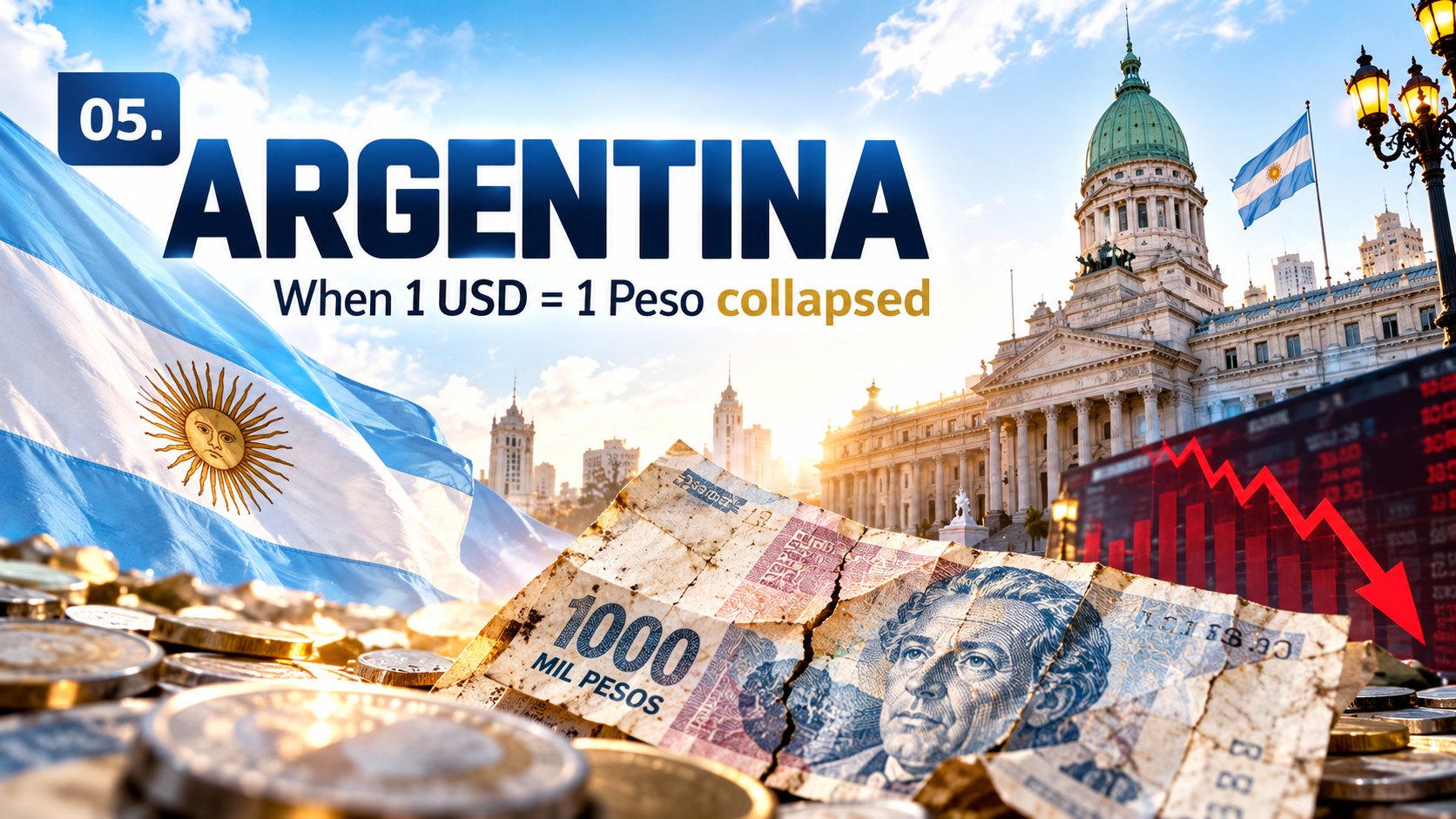
In Part 4 the market attacked Hong Kong’s peg from the outside. Argentina is the opposite story: a peg that trapped the system from the inside.
There is a very simple sentence:
1 USD = 1 Peso.
It sounds beautiful. Stable. Easy to understand.
And precisely because of that, it became one of the most memorable monetary experiments in modern history.
1. Argentina Once Won the War Against Inflation
In April 1991, Argentina introduced the Convertibility Plan, written into law by the Convertibility Law (Law 23,928).
The peso was pegged to the U.S. dollar at one to one: 1 peso = 1 USD, with the monetary base backed by reserves.
The initial result was impressive. Inflation, which had once been extreme, fell dramatically.
According to the IMF, consumer price inflation fell from over 2,000 percent in 1990 to 3.9 percent in 1994.
That was a real success.
But an initial success does not mean a system can survive forever.
2. The Trap of 1:1
If you say “peso = dollar,” markets begin behaving as though the two currencies are equal.
But Argentina’s economy was not the same as America’s.
- Productivity was different.
- Exports were different.
- Capital flows were different.
- Debt was different.
- Fiscal policy was different.
And this is where the problem began.
3. Debt in a Currency You Cannot Print
Argentina accumulated a large amount of foreign-currency obligations, in the public sector and inside the banking system.
This was extremely important.
When debt is denominated in dollars while income is largely earned in pesos, the whole system becomes highly sensitive to the exchange rate.
When confidence falls, everyone wants the same thing:
- People want dollars.
- Businesses want dollars.
- Investors want dollars.
But banks and governments cannot create dollars the way they can create pesos.
That is the fundamental difference.
4. And Then Trust Broke
Argentina entered a long recession that began in 1998. Financial and sovereign-debt problems became more and more severe.
At the start of December 2001, as bank runs accelerated, the government restricted cash withdrawals from bank accounts.
At the end of December 2001, Argentina defaulted on its sovereign debt.
On January 6, 2002, the government ended the currency board. The peg that had existed since 1991 was over.
1 peso = 1 USD was gone.
5. Corralito
Argentines have a word for that withdrawal limit: corralito, the “little fence.”
For an ordinary citizen, it meant:
“My money is in the bank, but I cannot freely take it out.”
That was the moment when the idea of “my money” became complicated.
6. Pesification
After the collapse, Argentina converted dollar deposits and dollar loans into pesos, at different rates.
Dollar deposits were converted at 1.40 pesos per dollar. Smaller dollar loans were converted at one to one.
Not everyone was affected in the same way. Savers and borrowers, banks and the state, all ended up with different losses.
And this is one of the biggest lessons:
When a monetary promise breaks, the consequences are not limited to the exchange rate. The rules decide who absorbs the loss.
7. Hong Kong and Argentina
These are two stories worth placing side by side.
Hong Kong: the market attacked from outside.
Argentina: the system became trapped from within.
Hong Kong shows how a currency board can be tested.
Argentina shows how an exchange-rate promise can become a cage.
And the next question is bigger: what happens if the entire world runs on debt?
What This Means for Your Money
You will probably never live through a corralito. But two lessons from Argentina apply to every household.
First, match your debt to your income. Argentina borrowed in a currency it could not print. The household version is a payment that can rise when your income cannot, such as a variable-rate balance or a payment tied to a promotional rate that ends.
Second, know what protects the money in your bank. In the U.S., the FDIC says deposit insurance “covers $250,000 per depositor, per FDIC-insured bank, for each account ownership category.” Crypto assets and investment products are not covered.
One step this week: list which of your balances could get more expensive without warning, then use our debt payoff calculator to see how fast you could clear them.
Sources: IMF, Press Release No. 96/15 on Argentina (inflation from over 2,000% in 1990 to 3.9% in 1994); IMF Independent Evaluation Office, “The Role of the IMF in Argentina, 1991–2002” (2003); Congressional Research Service, “The Argentine Financial Crisis: A Chronology of Events,” RL31582 (updated June 5, 2003); FDIC, “Understanding Deposit Insurance”.
This is Part 5 of The Architecture of Money, a DebtRoute series on how money really works. Next: When Debt Becomes a System. Follow DebtRoute on Facebook or join the DebtRoute Discord to get the next part. Educational content, not financial advice. Images are illustrative. DebtRoute is not affiliated with the Government of Argentina or the IMF.