
The Architecture of Money · Part 3
Who Really Creates Money? Central Banks, Commercial Banks and Credit
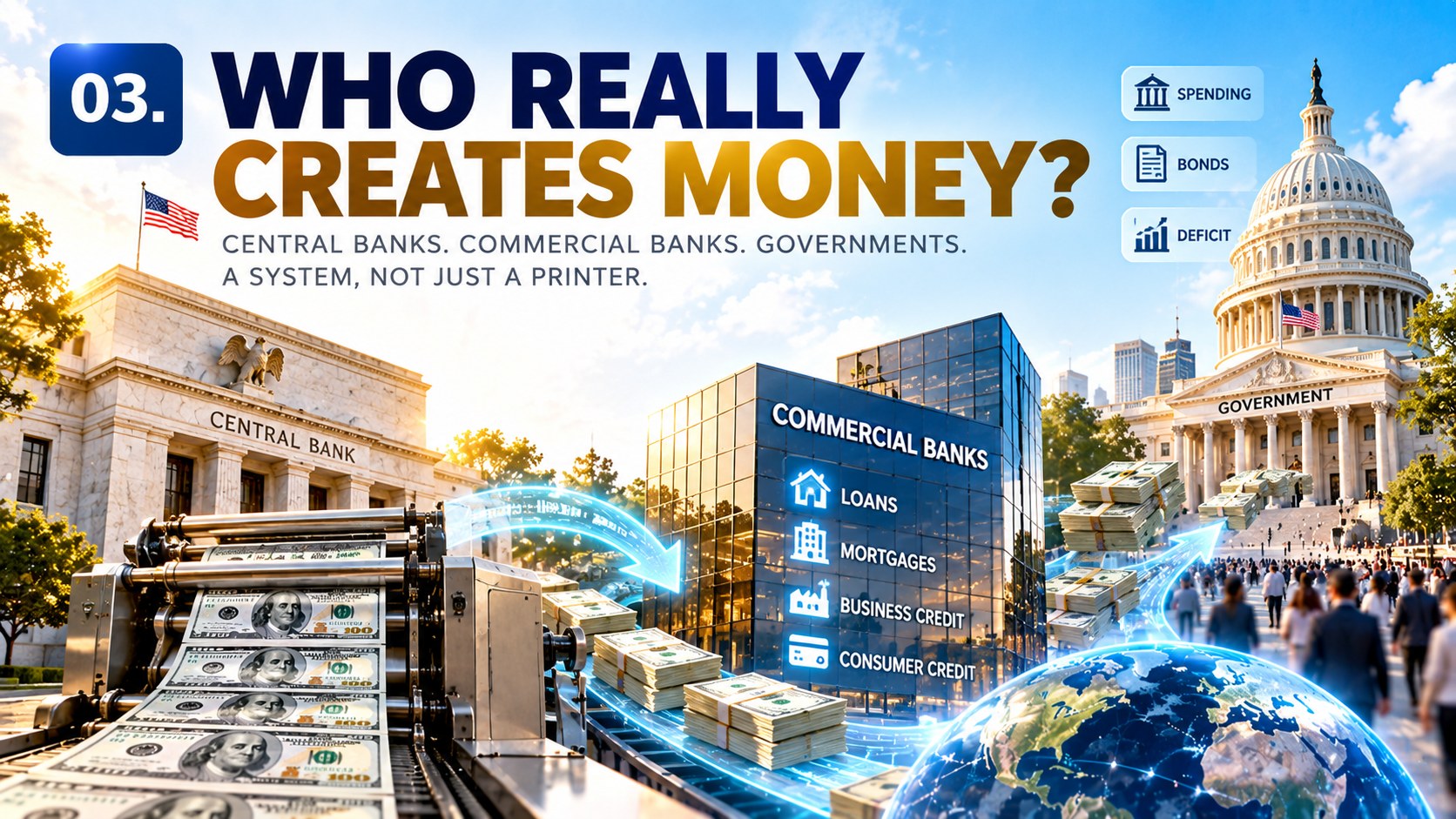
Central banks. Commercial banks. Governments. A system, not just a printer.
This is one of the things I think very few ordinary people are ever fully taught.
When we hear:
“The central bank prints money.”
we often imagine a factory.
Machines running.
Paper moving.
Money appearing.
But the modern monetary system is much more complicated.
Central Banks Create Part of the Foundation
Central banks create base money and operate the main tools of monetary policy.
But most of the money people use in the economy does not exist as physical banknotes.
It exists as:
bank deposits.
And this is where commercial banks enter the story.
A Loan Can Create a Deposit
Suppose you go to a bank.
You borrow $10,000.
The bank does not necessarily take exactly $10,000 in physical cash from a vault and hand it to you.
In modern banking, a loan can be accompanied by the creation of a new deposit in the banking system.
You look at your account:
+$10,000
You have money available to use.
The bank has a claim against you.
Your liability becomes an asset on the bank’s balance sheet.
This is why:
Credit and money are deeply connected.
So Who Controls It?
This is where the story becomes interesting.
It is not just one person.
It is not just the Fed.
It is not just commercial banks.
It is an entire system:
Central Bank
↓
Monetary Policy
↓
Banking System
↓
Credit
↓
Deposits
↓
Spending
↓
Economic Activity
And when credit contracts?
The flow of money can contract as well.
When credit expands?
The capacity for spending and investment can expand.
Is This Magic?
No.
It is accounting.
But it is a very powerful form of accounting.
Because:
one person’s debt can become another person’s asset.
Money is not only something we hold.
Money is also:
a network of promises.
And This Is the Point I Want to Debate
If the modern economy operates through credit…
then:
Debt is no longer merely a problem for the borrower.
It becomes part of the monetary system itself.
And once we understand that, the next two stories — Hong Kong and Argentina — become extremely important.
Because they show what happens when:
trust in money begins to be tested.
Want the bank-level view? Our earlier chapter Who Creates Money? Your Bank Does walks through a single loan step by step.
What This Means for Your Money
When you take out a loan or carry a credit card balance, you are not just borrowing “existing” money. You are signing one of the promises the whole system runs on, and that promise has a price: interest.
Before you sign, the federal Truth in Lending Act requires lenders to disclose the APR: the interest rate plus certain fees. The CFPB’s advice is to shop around and compare APR to APR across lenders, not just the monthly payment.
One step this week: list every debt you owe with its APR, highest first. That list tells you which promise is costing you the most. Then see your options in our guide to negotiating credit card debt.
Sources: Bank of England, “Money creation in the modern economy,” Quarterly Bulletin 2014 Q1; Federal Reserve — What is the money supply?; Federal Reserve H.6 Money Stock Measures; CFPB — Interest rate vs. APR
This is Part 3 of The Architecture of Money. New parts are added as they are published. Follow DebtRoute on Facebook or join the DebtRoute Discord to get new chapters first. Educational content, not financial advice.