
The Architecture of Money · Part 12
When Money Is No Longer Just Money: The Architecture Behind It
Law, power, debt, technology and trust: the finale of The Architecture of Money.
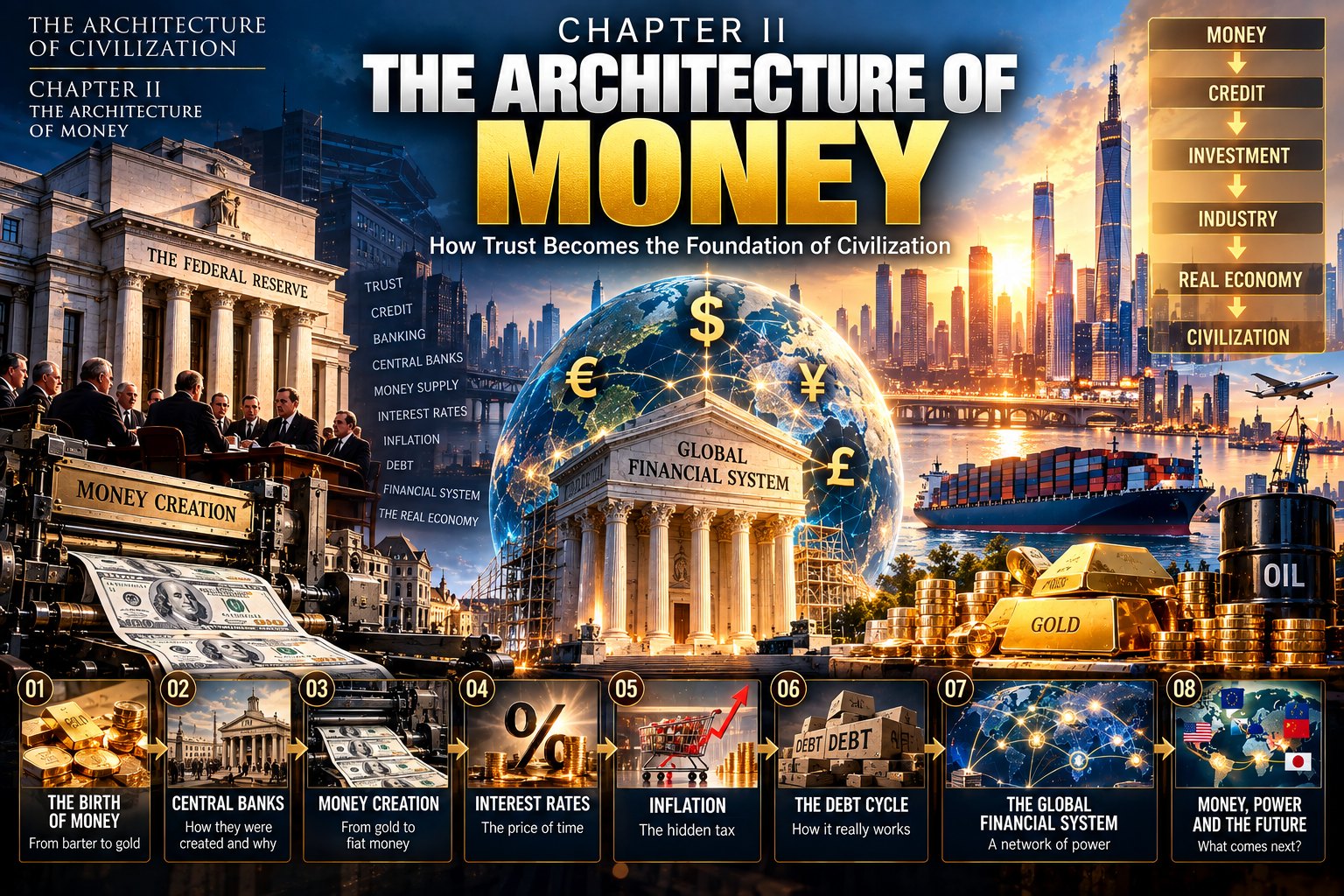
I began this series with one question: what is money?
After eleven articles, my answer has changed.
Money is not only paper. Not only gold. Not only a bank balance. Not only dollars. Not only bitcoin. Not only bonds. Not only stocks.
Money is a system of trust, built on law, power, technology, debt, assets and human behavior.
1. Look Back at the Numbers
The Federal Reserve: 12 Reserve Banks. 7 Governors serving staggered 14-year terms. 12 voting members on the FOMC. 9 directors at each Reserve Bank.
These are not just numbers. They are architecture.
2. Look Back at Gold
Once: money → gold.
Then: money → government + central bank + law.
Then: money → banks + credit.
Today: money → data + networks + technology.
And perhaps tomorrow: money → tokenized assets + blockchains + AI + programmable finance.
3. Look Back at Hong Kong
Hong Kong showed us that a currency promise can be tested by the market.
No war is required. Only a change in confidence.
4. Look Back at Argentina
Argentina showed that a monetary system can stay stable for years and still become fragile when the conditions behind it no longer match reality.
1 USD = 1 peso. A very simple sentence.
But behind it were debt, reserves, capital flows, exports, growth, confidence and policy.
5. Look Back at Debt
We discovered something strange: debt is not necessarily a flaw in the system. Debt is part of the system.
The modern economy needs credit. But the more credit grows, the more the system depends on one belief: that tomorrow, people will still be able to repay.
6. Look Back at Crypto
Maybe crypto is not “the dollar killer.” Maybe it is a new infrastructure layer.
If dollar stablecoins, tokenized securities and on-chain markets keep growing, an interesting possibility appears: crypto could become a new road through which the dollar continues to live in a digital world.
That is a hypothesis. But I think it is worth thinking about.
7. Look Back at BRICS
Maybe BRICS does not need to defeat the dollar. Maybe it only needs more choices.
The more choices a financial system has, the more a dominant center has to adapt.
8. And Finally, Gold
Gold still exists. Not because it is perfect, but because it has one unusual characteristic: it does not require someone else’s promise to exist.
But even gold has limits. A gold system cannot create unlimited monetary claims if the supply of gold is limited.
And any gold-backed currency must answer: what happens when everyone wants to exchange their money for gold at the same time?
9. What I Take Away
After looking through the Fed → gold → fiat → banks → debt → Hong Kong → Argentina → capital markets → crypto → BRICS → the dollar, I no longer see money the same way.
I see it as architecture.
Inside that architecture are money, debt, power, technology, banks, markets, states and people.
And most importantly: trust.
10. The Deepest Paradox of Money
A banknote does not have value simply because it is beautifully printed.
A token does not have value simply because it exists on a blockchain.
A bond does not have value simply because it carries a government seal.
A bank does not exist simply because it has a large building.
All of them depend on one thing:
The belief that other people will also believe.
Money is a system of collective trust.
A Final Question
If one day money becomes programmable, assets become tokenized, AI trades on behalf of humans, stablecoins settle instantly, blockchains record ownership and data becomes part of an asset…
Are we still talking about “money”?
Or about something larger: a system where money, technology, power, debt, information and human trust are combined into a new architecture?
If that happens, the biggest transformation may not be about who has the most money.
It may be about this:
Who builds and controls the architecture through which money is created, moved, owned and trusted?
That is exactly why this series is called The Architecture of Money.
Because in the end, money does not merely reflect civilization. Money is part of how civilization is built. That larger story continues in our free book, The Architecture of Civilization.
What This Means for Your Money
You do not need to control the architecture of money to control your place in it. Three questions from this series work for any household:
- Hong Kong: which of my debts get more expensive when rates jump?
- Argentina: do my payments depend on income I do not control?
- Gold: can I reach my emergency money the day I need it?
One step this week: answer those three questions on paper, then use our debt payoff calculator to build your own plan. Missed a part? Start from the series home.
Sources: Federal Reserve Board, “Structure of the Federal Reserve System”; Federal Reserve History, “Nixon Ends Convertibility of U.S. Dollars to Gold”; Sources for each topic are listed at the end of Parts 1–11..
This is Part 12 of The Architecture of Money, a DebtRoute series on how money really works. Thank you for reading the whole series. The story continues in Chapter III, The Architecture of National Power. Follow DebtRoute on Facebook or join the DebtRoute Discord to get the next part. Educational content, not financial advice. Images are illustrative. Educational series; hypotheses are labeled as such.