
The Architecture of National Power · Part 1
The Real Wealth of Nations
Why money, gold and oil are not enough
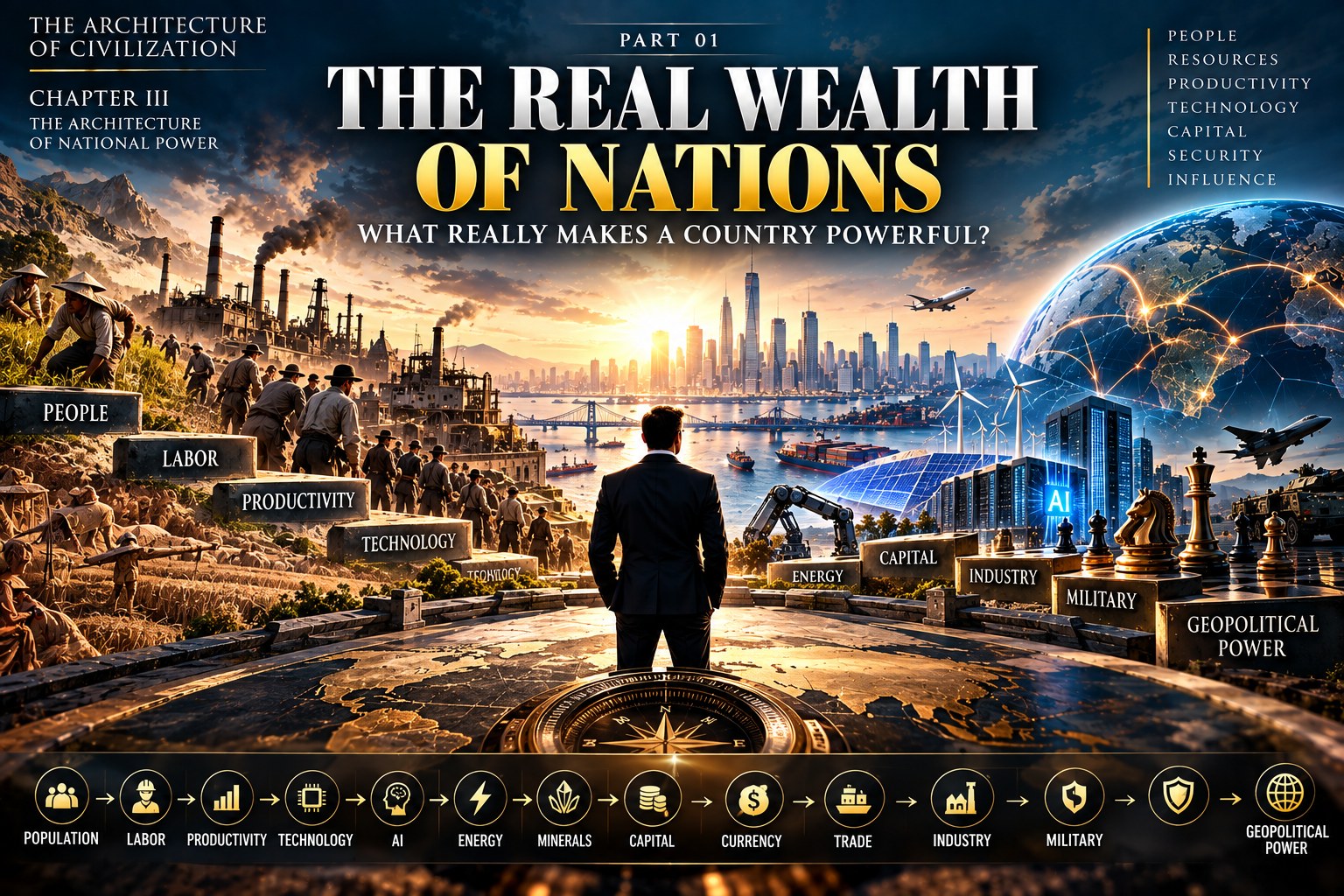
There is a question that looks simple:
Why do some nations become richer and more powerful while others stay trapped — even when they have people, money, land and resources?
Maybe the answer is money. Maybe gold. Maybe oil. Maybe a better government.
Each can matter. None reaches the deepest layer.
Imagine giving a country $1 trillion tomorrow.
It can buy machines, food, medicine, fuel, chips, weapons and technology. For a few years, life could change dramatically.
Then the money is spent.
If that country still cannot build the machines it needs, maintain its power plants, train the people who run the system, or produce anything the rest of the world wants to buy — the trillion dollars was purchasing power.
Not an engine.
The money was real. The productive capability behind it was not.
THE OLD MISTAKE: COUNTING THE TREASURE
For centuries, rulers measured wealth by what sat in the vault. Gold and silver financed armies and symbolized sovereignty. Empires crossed oceans to take them.
But treasure alone never guaranteed prosperity. A kingdom could pile up precious metals while its own production stayed weak. If more money chased the same goods, prices rose. If the treasure was spent on war and prestige, it vanished — and left nothing stronger behind.
The question was never whether gold, oil or land matter.
They do.
The question is what a society can do with them.
WEALTH IS A MACHINE, NOT A PILE
A powerful country turns:
people into skills,
skills into productivity,
productivity into products,
products into profits,
profits into capital,
capital into technology.
Then the cycle starts again.
Every link matters. Skilled workers without equipment stay unproductive. Modern machines without reliable electricity sit idle. A factory without logistics cannot deliver. A country that creates value but cannot protect the institutions behind investment cannot keep it.
The strongest economies are not the ones that never suffer a crisis.
They are the ones with more ways to respond when one arrives.
So the real question is not, “How much does this country own?”
It is:
“What can this country still produce when the outside world becomes difficult?”
When trade is disrupted. When capital becomes expensive. When a critical supplier disappears.
That question redraws the map of power — away from headline GDP and financial markets, toward factories, skills, energy, supply chains and institutions.
Perhaps national strength is not something a country simply possesses.
Perhaps it is something a country can reproduce.
And if that is true, the first component of the machine is not money.
It is people.
What This Means for Your Money
A household has its own version of productive capacity: income it can keep earning and savings it can reach in a bad month. Ask the P1 question of your own budget: what could you still pay if one paycheck stopped?
One step this week: read our emergency fund calculator.
This is Part 1 of The Architecture of National Power, Chapter III of DebtRoute’s free book The Architecture of Civilization. A new part publishes every day. Follow DebtRoute on Facebook or join the DebtRoute Discord to get the next part. Educational content, not financial advice. Images are illustrative. Hypotheses are labeled as such.