
The Architecture of Civilization · Part 6
Who Creates Money? Your Bank Does, Every Time It Makes a Loan
The Invisible Banking System Behind Modern Civilization
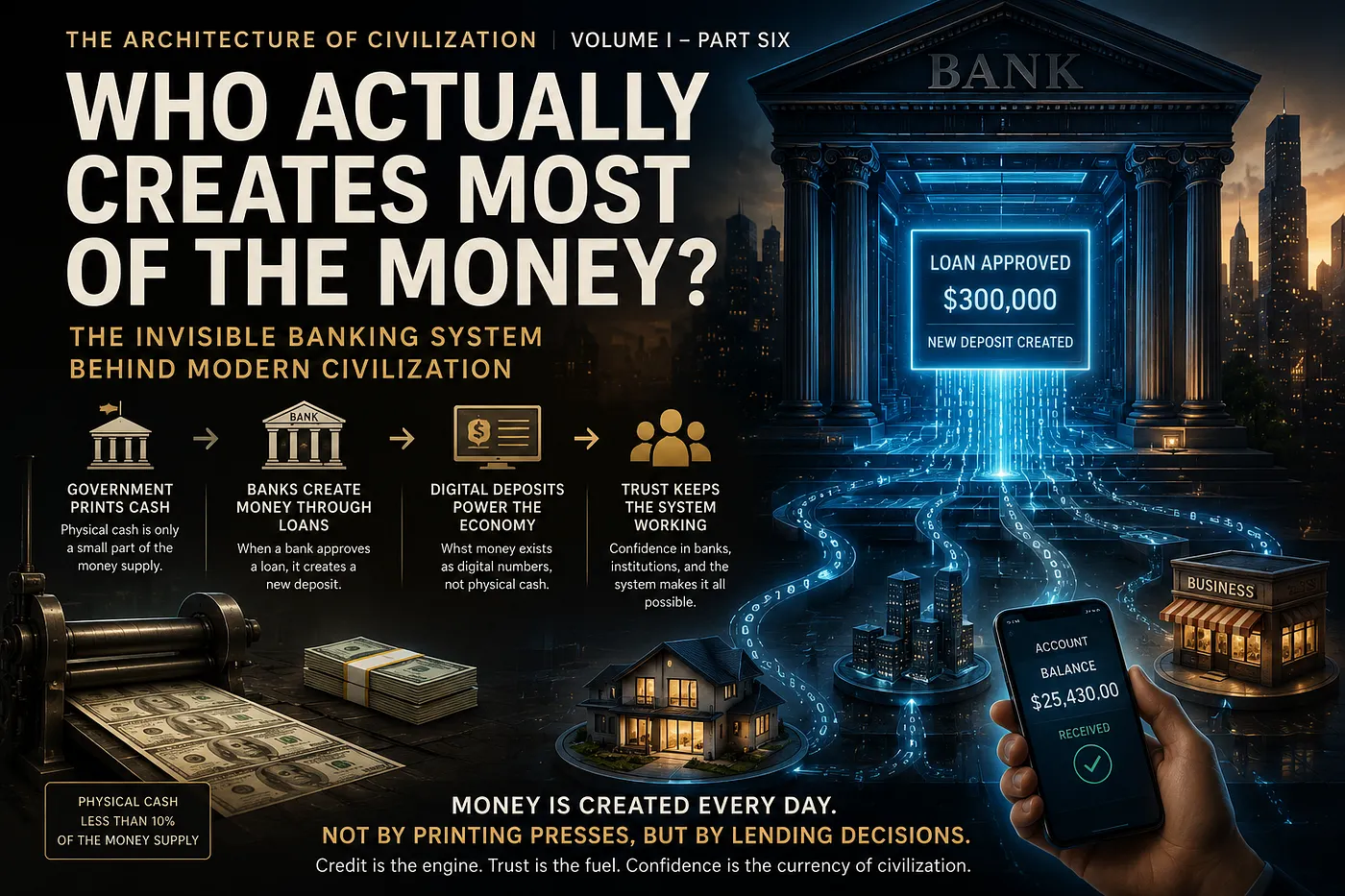
“Most people believe governments print money. In reality, most modern money is never printed at all.”
Introduction
Ask almost anyone where money comes from.
Most will give the same answer.
“The government prints it.”
It seems obvious.
After all, every banknote carries the seal of a central bank.
Every coin is minted by the state.
But that picture tells only a small part of the story.
Look around your own life.
Your salary arrives electronically.
You swipe a debit card.
You transfer money through an app.
You pay bills online.
No paper changes hands.
No truck delivers cash.
Yet new money appears inside bank accounts every single day.
If governments are not printing all of it…
who is?
The answer surprises almost everyone.
The Great Misunderstanding
When people hear the phrase money supply, they often imagine stacks of banknotes stored inside vaults.
Reality is very different.
Physical cash represents only a fraction of modern money.
The overwhelming majority exists only as digital bank deposits.
Those deposits are created not by printing presses…
but through the banking system itself.
Understanding this changes the way we see finance forever.
The Loan That Creates Money
Imagine you walk into a bank.
You qualify for a mortgage.
The bank approves a loan of $300,000.
Does the bank wheel out a vault full of cash?
No.
Instead, something remarkable happens.
The bank credits your account with a new deposit.
Your balance suddenly increases.
At that moment, new money enters the economy.
The house seller receives payment.
The seller deposits the funds elsewhere.
Those deposits circulate through the financial system.
No printing press was required.
The money was created through lending.
Why Banks Can Do This
This sounds impossible at first.
How can banks create money?
Because modern banking operates on confidence, regulation, and balance sheets — not on warehouses filled with banknotes.
When banks issue loans, they simultaneously create matching deposits.
The loan becomes an asset.
The deposit becomes a liability.
Both appear on the balance sheet at the same time.
Money expands alongside credit.
This process powers investment, home ownership, business creation, and economic growth.
It also explains why credit cycles have such a powerful influence on the economy.
Credit Is the Engine
Modern economies are driven less by cash…
and more by credit.
Businesses borrow to expand.
Families borrow to buy homes.
Students borrow to invest in education.
Governments borrow to finance long-term projects.
Every new loan has the potential to increase economic activity.
But every loan also creates future obligations.
Money and debt grow together.
One cannot fully understand modern money without understanding credit.
The Hidden Architecture
This realization changes one of the oldest assumptions about money.
Money is not simply something stored.
It is something continuously created and extinguished.
When new loans are issued, money expands.
When loans are repaid, money contracts.
The monetary system behaves less like a warehouse…
and more like a living network.
Its size changes every day.
Usually without anyone noticing.
Closing Reflection
For centuries, people searched for treasure buried beneath the ground.
Modern civilization discovered something even more valuable.
The ability to create purchasing power through trusted financial institutions.
This innovation transformed global growth.
It also transformed financial risk.
Because when money can be created through credit…
confidence becomes more important than ever.
The architecture of money is no longer built only by governments.
It is built every day by millions of lending decisions.
What This Means for Your Money
Here’s my take: once you know that banks create new money when they make loans, a credit card offer looks different. The Bank of England explained this plainly in its 2014 paper, Money Creation in the Modern Economy: in the modern economy, most money is created by commercial banks when they lend.
So when you swipe a card, you aren’t borrowing a pile of saved cash. You’re helping create new money, and you pay interest on it. Americans owed about $1.26 trillion on credit cards in Q2 2026, according to the New York Fed. Every dollar of that is a promise someone is paying interest on, every month.
If some of that balance is yours, here’s a clear way out: How to Get Out of Credit Card Debt.
The DebtRoute Lens
Most people spend their lives trying to earn money.
Few ever ask where money comes from.
That question changes everything.
Once you understand that modern money is largely created through credit…
you begin to see banks differently.
You begin to see debt differently.
And perhaps, for the first time…
you begin to see civilization itself differently.
End of Part Six
Next in the Series
Volume I, Part Seven
Why Debt Is Not the Opposite of Money: It Is Part of the Same System
Sources: Bank of England Quarterly Bulletin 2014 Q1; Federal Reserve Bank of New York, Household Debt and Credit Report (Q2 2026). Educational content, not financial advice.
Zoom out: Who Really Creates Money? (The Architecture of Money, Part 3) follows the same loan through the whole system, from the central bank to everyday spending.
Part of The Architecture of Civilization, a free plain-English book on money, debt and trust. Follow DebtRoute on Facebook or join the DebtRoute Discord to get new chapters first. Educational content, not financial advice.