
The Architecture of Civilization · Part 7
Why Debt Isn’t the Opposite of Money
The Hidden Relationship Between Credit, Money, and Economic Growth
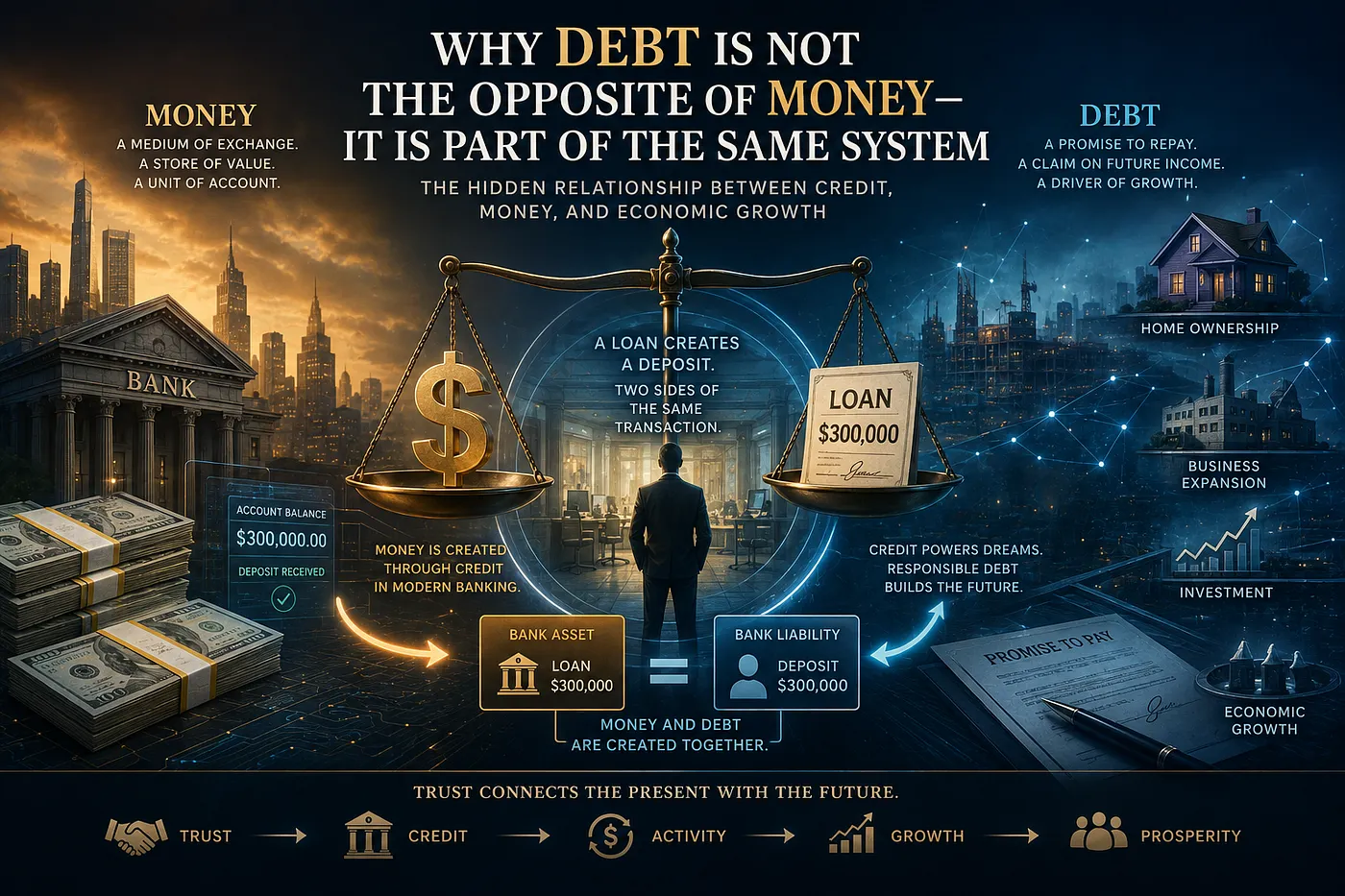
“Most people think money and debt are opposites. In modern banking, they are often two sides of the same transaction.”
Introduction
We are taught a simple story about money.
You earn it.
You save it.
You spend it.
And if you borrow it, you owe it back.
So it seems natural to think of money and debt as opposites.
Money is what you have.
Debt is what you owe.
But modern financial systems are more complicated than this.
A bank loan does not simply move existing money from one person’s pocket to another.
When a commercial bank makes a loan, it can simultaneously create a deposit in the borrower’s account. The loan appears as an asset on the bank’s balance sheet, while the new deposit appears as a liability.
In other words:
A loan can create money.
And that simple fact changes the way we should think about debt.
The Moment Money and Debt Meet
Imagine that you want to buy a $300,000 house.
You approach a bank.
After evaluating your application, the bank approves the mortgage.
What happens next?
You don’t necessarily receive a truck filled with $300,000 in banknotes.
Instead, your bank account can be credited with a $300,000 deposit.
At the same time, the bank records a $300,000 loan as an asset.
One transaction creates two sides of a balance sheet.
A financial claim for one side becomes a financial obligation for another.
This is one of the fundamental mechanisms through which commercial banking creates deposits.
Money Is Not a Warehouse
This changes the mental model most people have about banking.
We tend to imagine a bank as a warehouse.
People deposit money.
The bank stores it.
Someone else borrows the same money.
But modern banking cannot be understood simply as a warehouse transferring physical cash between people.
Deposits are themselves liabilities of banks, while loans are assets. The banking system operates through balance sheets, payment flows, capital, liquidity, regulation, and confidence.
The important insight is this:
Money is not merely stored.
It can be created and extinguished through financial activity.
When bank credit expands, deposits can expand.
When loans are repaid, deposits associated with those loans can contract.
The system is dynamic.
But Banks Cannot Create Unlimited Money
This is where the story becomes more interesting.
Saying that banks can create deposits through lending does not mean banks can create unlimited money without constraints.
Banks face capital requirements.
Liquidity constraints.
Credit risk.
Funding costs.
Regulation.
And, perhaps most importantly, borrowers who must actually qualify for credit.
A bank cannot simply create purchasing power without consequences.
Every loan creates an asset that must be repaid.
If borrowers default, the bank absorbs losses.
If confidence disappears, liquidity can become a critical problem.
The system therefore contains its own restraints.
Where the Central Bank Enters
Commercial banks are not the only institutions involved in the monetary system.
Central banks operate a different layer.
In the United States, the Federal Reserve provides reserve accounts to depository institutions and uses monetary policy to influence money-market conditions and the broader growth of money and credit.
The Federal Reserve also publishes separate measures of currency, deposits, and broader monetary aggregates.
That distinction matters.
There is central-bank money.
There are commercial-bank deposits.
And there are many other forms of financial claims circulating throughout the economy.
They interact.
But they are not identical.
The Economic Engine Called Credit
Why does this matter beyond banking theory?
Because credit allows economic activity to happen before someone has accumulated all the money required to finance it.
A company can borrow to build a factory.
A family can borrow to purchase a home.
An entrepreneur can borrow to expand a business.
A farmer can finance equipment before the next harvest.
Credit connects the present with expectations about the future.
The borrower is effectively saying:
I believe I can produce enough future income to justify spending today.
The lender is saying:
I believe your promise is credible enough to finance.
That is why credit is ultimately another form of trust.
The Dangerous Side of the Equation
But the same mechanism that accelerates economic activity can amplify financial instability.
When credit expands rapidly, asset prices can rise.
Businesses may take on greater leverage.
Households may assume larger obligations.
Investors may underestimate risk.
And when expectations reverse, the process can work in the opposite direction.
Credit contracts.
Spending weakens.
Asset prices can fall.
Defaults can increase.
Confidence deteriorates.
The system that once accelerated growth can begin accelerating contraction.
This is why financial crises are rarely just about money.
They are often about confidence in future promises.
What This Means for Your Money
Here’s my take: debt isn’t good or bad by itself. It’s a tool that moves tomorrow’s income into today. A mortgage can build a home. A credit card balance at 22% can quietly take one apart.
Across the country, that trade is huge. American households owed about $18.8 trillion in Q2 2026, according to the New York Fed’s Household Debt and Credit Report. That includes mortgages, auto loans, student loans and credit cards. We break the numbers down in plain English in our U.S. Consumer Debt Report 2026.
If your own debt has stopped being a tool and started being a weight, learn your options here: What Is Debt Relief, and Who Is It For?
The DebtRoute Lens
Perhaps the most important lesson is this:
Debt is not simply money that someone has lost.
In modern financial systems, debt and money are often created together.
One person’s financial asset can be another person’s obligation.
One person’s deposit can exist alongside another person’s loan.
The system works because society believes those promises can be honored.
And that brings us back to the beginning of our journey.
Gold required trust.
Paper required trust.
Digital money requires trust.
And debt requires perhaps the most powerful form of trust of all:
trust in the future.
Because every loan is ultimately a bet on tomorrow.
Closing Reflection
Human civilization has always borrowed from the future.
Ancient kingdoms borrowed to finance wars.
Merchants borrowed to finance voyages.
Industrial companies borrowed to build factories.
Modern economies borrow on an unprecedented scale.
The technology changed.
The institutions changed.
The currencies changed.
But the fundamental question remained:
How much of tomorrow are we willing to spend today?
That question is not merely financial.
It is civilizational.
And once we understand that money and debt are deeply connected, another question becomes unavoidable:
What happens when a civilization begins depending on debt faster than the real economy can support it?
That is where the architecture becomes much more interesting.
Next in the Series
Volume I, Part Eight
The Banking System Nobody Sees
Behind every payment lies an enormous network of institutions, balances, promises, and invisible settlements. Most people use it every day without ever seeing it.
Sources: Federal Reserve Bank of New York, Household Debt and Credit Report (Q2 2026). Educational content, not financial advice.
Part of The Architecture of Civilization, a free plain-English book on money, debt and trust. Follow DebtRoute on Facebook or join the DebtRoute Discord to get new chapters first. Educational content, not financial advice.