
The Architecture of Money · Part 2
When Money Stopped Being Gold: From Gold to Fiat to Digital Money
From gold to fiat money to digital money, and why trust is what really stands behind your dollars.
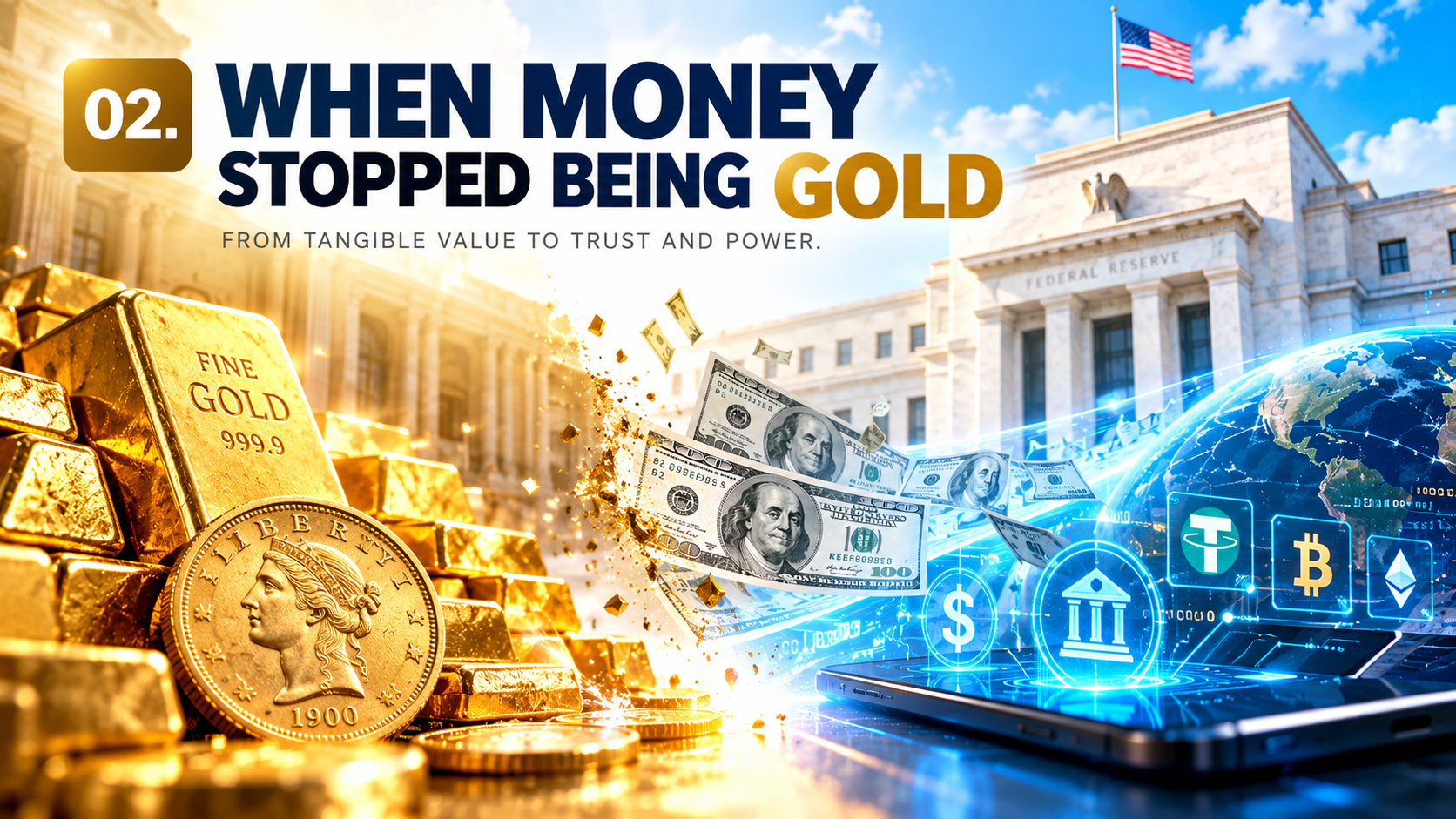
There was a time when money could be held in your hand and its material value could be seen.
Gold.
Silver.
Copper.
Things humans could dig out of the ground, weigh, hold, and exchange.
But today?
A huge part of our money exists only as numbers on a screen.
You open your banking app.
+$2,000.
You do not see $2,000 sitting inside your phone.
There is no gold bar behind it.
There is no safe containing exactly that amount of cash.
You only see:
a number.
So why do we still believe it is money?
From Gold to Paper
Historically, paper money was connected to gold through different monetary arrangements.
After World War II, Bretton Woods created a system in which the U.S. dollar was linked to gold at $35 per ounce, while other currencies were linked to the dollar through agreed exchange-rate arrangements.
But that system eventually became unsustainable.
On August 15, 1971, President Richard Nixon closed the “gold window,” ending the ability of foreign governments to convert dollars into gold at the fixed rate.
This was a major turning point in the collapse of Bretton Woods.
From that point, the dollar was no longer a promise to exchange for gold at a fixed rate. It became fiat money.
But What Actually Gives Money Value?
This is my favorite question.
If it is not gold… then what stands behind it?
The answer is: trust.
- Trust in government.
- Trust in banks.
- Trust in the legal system.
- Trust that other people will also accept the currency.
And deeper than that: trust that the currency will still have value tomorrow.
That is an invisible kind of asset.
But Money Keeps Changing
Today, money is no longer just paper. It has become:
- bank balances and deposits
- electronic payments and cards
- mobile banking
- stablecoins and crypto
- tokenized assets and other digital assets
We are moving from Gold → Paper → Numbers → Code.
This is not merely a technological change. It is a change in how human beings define: “What do I trust?”
DebtRoute Moment
I used to think gold was the opposite of paper money. But the more I look at history, the more I see something different:
Gold is not the opposite of paper money. Gold is the memory of trust.
When people lose trust in paper money, they return to gold.
When they trust banks, they keep money in banks.
When they trust the Internet, they move money onto screens.
And if one day people trust blockchain strongly enough… money could become something completely different.
But there is an even bigger question: Who actually creates money? We will answer that in the next part.
What This Means for Your Money
If most of your money is now just numbers on a screen, the protection behind those numbers matters.
At an FDIC-insured bank, deposits are insured up to $250,000 per depositor, per insured bank, for each account ownership category. Credit unions insured by the NCUA offer the same standard coverage.
Crypto assets are not FDIC-insured. If you hold stablecoins or crypto through an app, that balance does not have the same protection as a bank deposit.
One step this week: open your banking app and confirm your bank or credit union is FDIC- or NCUA-insured. Then check how emergency savings fit your budget with our emergency fund calculator.
Sources: Federal Reserve History — Creation of the Bretton Woods System; Federal Reserve History — Nixon Ends Convertibility of U.S. Dollars to Gold; FDIC — Deposit Insurance; FDIC — Deposit Insurance and Crypto Companies; NCUA — Share Insurance Coverage
This is Part 2 of The Architecture of Money. New parts are added as they are published. Follow DebtRoute on Facebook or join the DebtRoute Discord to get new chapters first. Educational content, not financial advice.