
The Architecture of Civilization · Part 8
What Really Happens When You Tap “Pay”
Behind every payment lies an enormous network of institutions, balances, promises, and invisible settlements. Most people use it every day without ever seeing it.
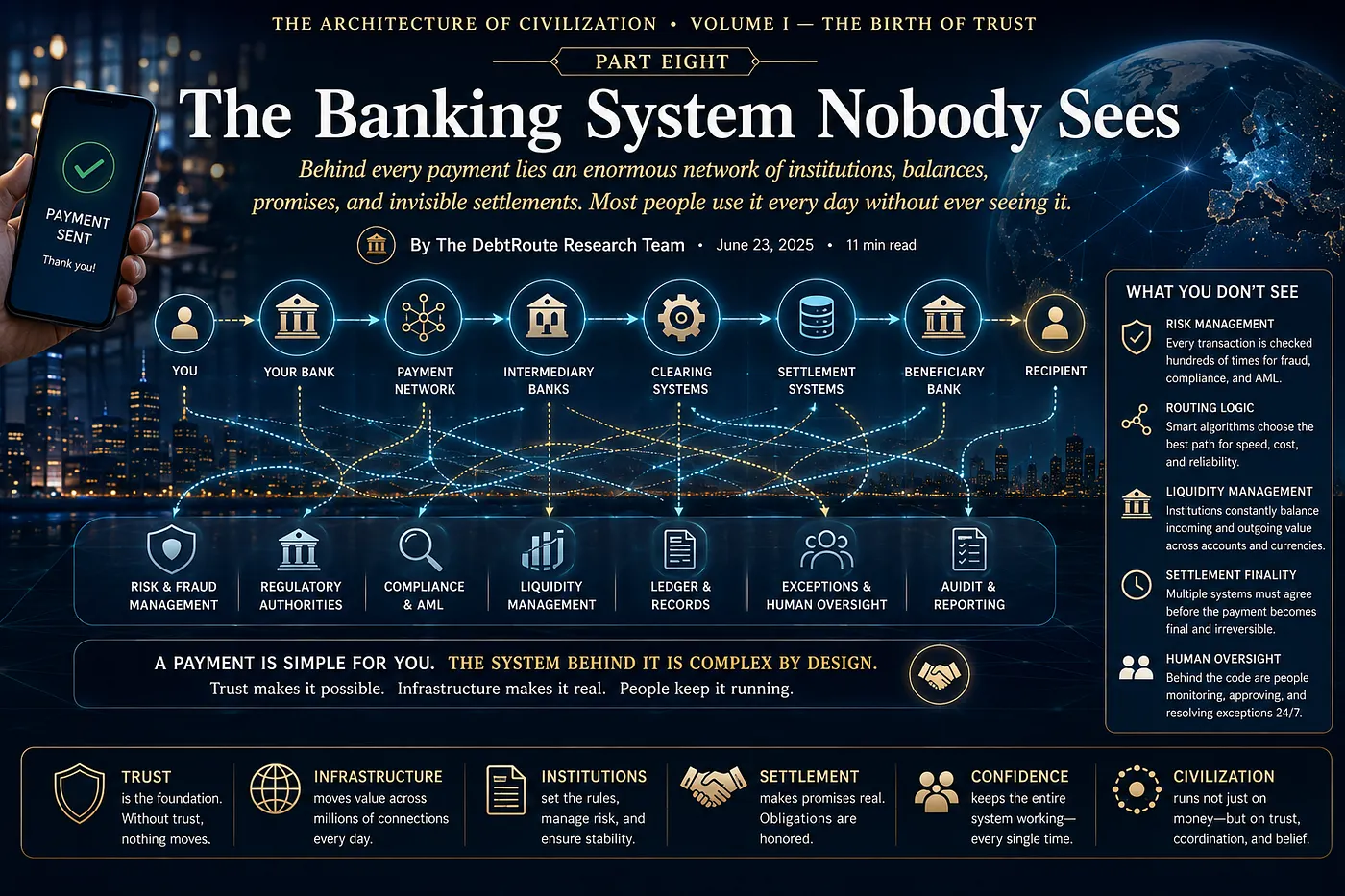
“A payment is simple. The system behind it is not.”
You tap your phone.
A message appears:
Payment sent.
For you, the transaction may feel almost effortless.
One tap.
One confirmation.
Done.
But behind that single moment is one of the most complex machines ever built by human civilization.
Your money does not simply travel from your phone to another person’s phone.
It moves through a network of institutions, accounts, rules, databases, risk controls, and settlement systems.
Most of them are invisible to you.
Yet your payment depends on all of them.
The Illusion of Simplicity
Modern financial technology has made payments feel almost instantaneous.
Buy something in another country.
Send money to a friend.
Pay a business with your phone.
The experience is simple because the complexity has been hidden.
Behind every successful transaction is a choreography that must work correctly — again and again, millions of times a day.
The remarkable achievement is not that we can tap a screen.
It is that an enormous system can make the result feel ordinary.
The Many Players in the Shadows
When a payment travels, it rarely moves in a straight line.
Depending on the transaction, multiple participants may be involved:
- Your bank
- The recipient’s bank
- Payment networks
- Intermediary financial institutions
- Clearing systems
- Settlement systems
- Regulators
- Fraud and compliance systems
Each has a different responsibility.
Some route the transaction.
Some verify it.
Some manage risk.
Some reconcile records.
Some ultimately settle the obligations between institutions.
None may be visible to the person holding the phone.
Yet every layer matters.
Clearing Is Not Settlement
This distinction is rarely visible to consumers.
A payment can be authorized before it is finally settled.
Clearing involves the exchange and reconciliation of transaction information and obligations between financial institutions.
Settlement is the process through which those obligations are ultimately discharged.
The difference matters because a payment that appears complete to a consumer may still pass through additional institutional processes before final settlement.
The screen shows the experience.
The financial system manages the reality.
The Invisible Ledger
At the center of modern finance are records.
Who owns what?
Who owes whom?
Which institution has a claim?
Which institution has an obligation?
Which transaction has been authorized?
Which transaction has been settled?
The financial system constantly updates these relationships.
Money is therefore not simply a physical object moving through space.
It is also a continuously maintained network of records.
That is why the integrity of financial information is so important.
If the records cannot be trusted, the system cannot function.
What You Don’t See
A payment may trigger processes that the customer never notices.
Risk Management
Transactions can be examined for fraud, unusual behavior, sanctions concerns, or other risks.
Routing Logic
Systems determine where transactions should go and which infrastructure should process them.
Liquidity Management
Financial institutions must manage incoming and outgoing obligations across accounts, currencies, and time.
Settlement
Institutions must ultimately reconcile their obligations so that the financial system remains balanced.
Human Oversight
Behind automated systems are people monitoring, investigating, approving, and resolving exceptions.
The more seamless the payment becomes…
the easier it is to forget how much infrastructure makes that seamlessness possible.
The Architecture of Confidence
This brings us back to the central theme of this series.
Trust.
You trust your bank to record your balance correctly.
The bank trusts other institutions to honor their obligations.
Payment networks depend on standardized rules.
Settlement systems depend on accurate records.
Regulators establish frameworks for the system to operate within.
And ultimately, everyone depends on confidence that the infrastructure will still function tomorrow.
The banking system is therefore more than a collection of companies.
It is a network of promises.
When the Invisible Becomes Visible
Most of the time, people never think about this architecture.
And that is actually a sign that it works.
We notice infrastructure when it fails.
A payment is rejected.
A bank system goes offline.
A transfer is delayed.
A fraud control blocks a legitimate transaction.
A financial institution experiences a liquidity crisis.
Suddenly, the invisible architecture becomes visible.
The ordinary payment reveals the extraordinary system beneath it.
What This Means for Your Money
Here’s my take: the hidden payment system works so well that we forget to watch it. That’s a mistake, because speed matters when something goes wrong.
If someone makes an unauthorized transfer from your bank account or debit card, federal rules limit what you can lose, but the clock is ticking. According to the CFPB, if you report a lost or stolen card within two business days, your loss is generally capped at $50. Wait longer and the cap goes up. If you don’t report an unauthorized charge within 60 days after your statement is sent, you could lose all of it.
My simple habit: check your accounts once a week, and turn on alerts for every transaction. And when money is tight and the payments pile up, this guide helps you decide what to pay first: Which Bills to Pay First When Money Is Tight.
The DebtRoute Lens
We often think of civilization as the buildings we can see.
Banks.
Skyscrapers.
Factories.
Ports.
Roads.
But some of civilization’s most important infrastructure cannot be seen at all.
It exists in ledgers.
Protocols.
Rules.
Institutions.
Settlement mechanisms.
And shared expectations.
The modern economy does not function because money physically moves quickly.
It functions because information, obligations, and trust can move reliably.
That is the deeper architecture.
Closing Reflection
The next time you tap your phone to pay for something, pause for a moment.
You are not simply sending money.
You are activating a vast institutional network built over generations.
A network designed to answer questions you never have to ask:
Who is paying?
Who is receiving?
Is the transaction legitimate?
Who owes whom?
Has the obligation been cleared?
Has it been settled?
Can the records be trusted?
The brilliance of modern banking is that you rarely need to know the answers.
You simply tap.
And the system works.
Until it doesn’t.
And when it doesn’t, we discover something important:
The banking system was never invisible because it was unimportant.
It was invisible because we trusted it.
Next in the Series
Volume I, Part Nine
What Happens When Trust Breaks?
Every financial system looks stable — until confidence begins to disappear.
Sources: Consumer Financial Protection Bureau, Unauthorized Transactions. Educational content, not financial advice.
Part of The Architecture of Civilization, a free plain-English book on money, debt and trust. Follow DebtRoute on Facebook or join the DebtRoute Discord to get new chapters first. Educational content, not financial advice.