
The Architecture of Civilization · Part 5
Where Is Your Money, Really? Why Most Money Is Just Numbers
Why Most Wealth Exists Only as Numbers
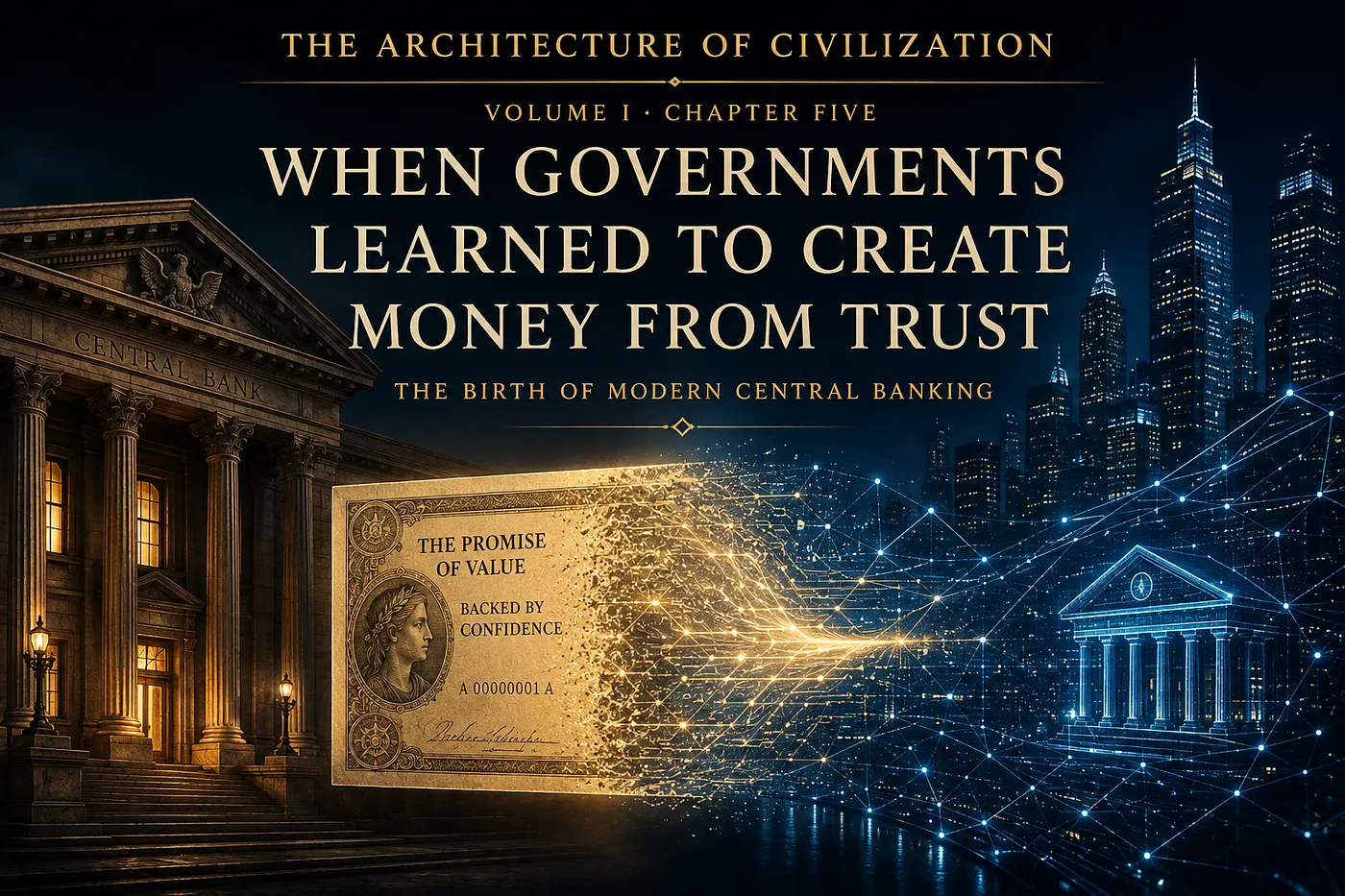
“The greatest transformation in the history of money happened so quietly that most people never noticed it.”
Introduction
Take out your wallet.
Count the cash inside.
Now open your banking app.
Look at the balance displayed on your screen.
Which number is larger?
For most people living in modern economies, the answer is obvious.
Most of their money does not exist inside their wallet.
It exists somewhere else.
But where?
Inside a bank?
Inside a vault?
Inside a computer?
Or nowhere at all?
This simple question reveals one of the most extraordinary facts about modern civilization:
Most of the world’s money has no physical form.
No paper.
No gold.
No silver.
No coins.
Only numbers.
Yet those invisible numbers buy homes, companies, airplanes, factories — and sometimes entire nations.
How did humanity reach this point?
From Objects to Information
For thousands of years, money was something people could touch.
A gold coin.
A silver bar.
A sack of grain.
A piece of paper.
Ownership was physical.
Transfer required movement.
Distance slowed commerce.
Then something changed.
Money stopped being an object.
It became information.
Today, a payment often moves across continents in seconds — not because trucks carry cash, but because computer systems update records.
Nothing physical travels.
Only information changes.
Civilization quietly entered the Information Age of Money.
The Ledger Is More Important Than the Vault
Imagine two banks.
One owns a vault filled with gold.
The other operates a secure digital ledger trusted by millions of customers.
Which institution moves more money each day?
In today’s world, the answer is obvious.
The ledger matters more than the vault.
Modern banking is built on records.
Balances.
Transactions.
Promises.
Every transfer you make is fundamentally an update to a shared accounting system.
Money has become less about possession…
and more about trusted information.
Trust Travels Faster Than Gold
Gold moves at the speed of transportation.
Digital money moves at the speed of communication.
This difference transformed civilization.
Global supply chains.
International trade.
Online commerce.
Financial markets.
Remote work.
Cross-border investment.
None of these could operate at today’s scale if every payment required moving physical metal.
Information allowed money to become almost frictionless.
But something else became even more important.
Trust.
Because information is valuable only when people believe it is accurate.
The Invisible Risk
Invisible money offers extraordinary efficiency.
It also creates new vulnerabilities.
A cyberattack can disrupt payment systems.
A software error can affect millions of transactions.
A banking panic can spread globally within hours through smartphones and social media.
The faster trust moves…
the faster fear can move as well.
Modern financial crises are no longer limited by geography.
They can travel at the speed of information.
Closing Reflection
Human civilization once measured wealth by what people could hold.
Today, it increasingly measures wealth by what institutions can verify.
Money has evolved from metal…
to paper…
to information.
Each transformation expanded economic possibility.
Each also demanded a deeper form of trust.
Perhaps the greatest invention was never gold.
Nor paper.
Nor computers.
Perhaps it was humanity’s extraordinary ability to believe in a shared system that cannot be seen — but can shape the lives of billions.
DebtRoute Perspective
When people ask, “Where is my money?”, they often expect a physical answer.
The more profound answer is this:
Your money exists wherever society continues to trust the records that define it.
Civilization is no longer built on vaults.
It is built on synchronized belief.
What This Means for Your Money
Here’s my take: if money is mostly numbers on a screen, then the numbers you track are the money you control. Look at the Federal Reserve’s H.6 money stock data. In August 2026, currency in circulation was about $2.39 trillion, while the broader M2 money supply was about $23.34 trillion. Put simply, roughly 9 of every 10 dollars in that measure are records, not cash.
That’s also why digital spending feels painless. A tap doesn’t feel like handing over bills, so money slips away quietly. The fix is simple and a little old-fashioned: give every dollar a job before the month starts.
Try it in five minutes with our free Budget Calculator.
Key Takeaways
- Most modern money exists as digital records rather than physical cash.
- Banking systems rely on trusted ledgers more than physical vaults.
- Digital money transformed the speed and scale of global commerce.
- As money became information, trust became even more valuable.
- Every digital payment is ultimately an act of confidence in a shared system.
Coming Next
Part Six: Who Actually Creates Most of the Money?
The answer surprises almost everyone. It is not who most people think.
Sources: Federal Reserve H.6 Money Stock Measures (Aug. 2026). Educational content, not financial advice.
Part of The Architecture of Civilization, a free plain-English book on money, debt and trust. Follow DebtRoute on Facebook or join the DebtRoute Discord to get new chapters first. Educational content, not financial advice.