
The Architecture of Civilization · Part 4
What Is Fiat Money? The Day Governments Stopped Needing Gold
The Birth of Fiat Money and the New Architecture of Trust
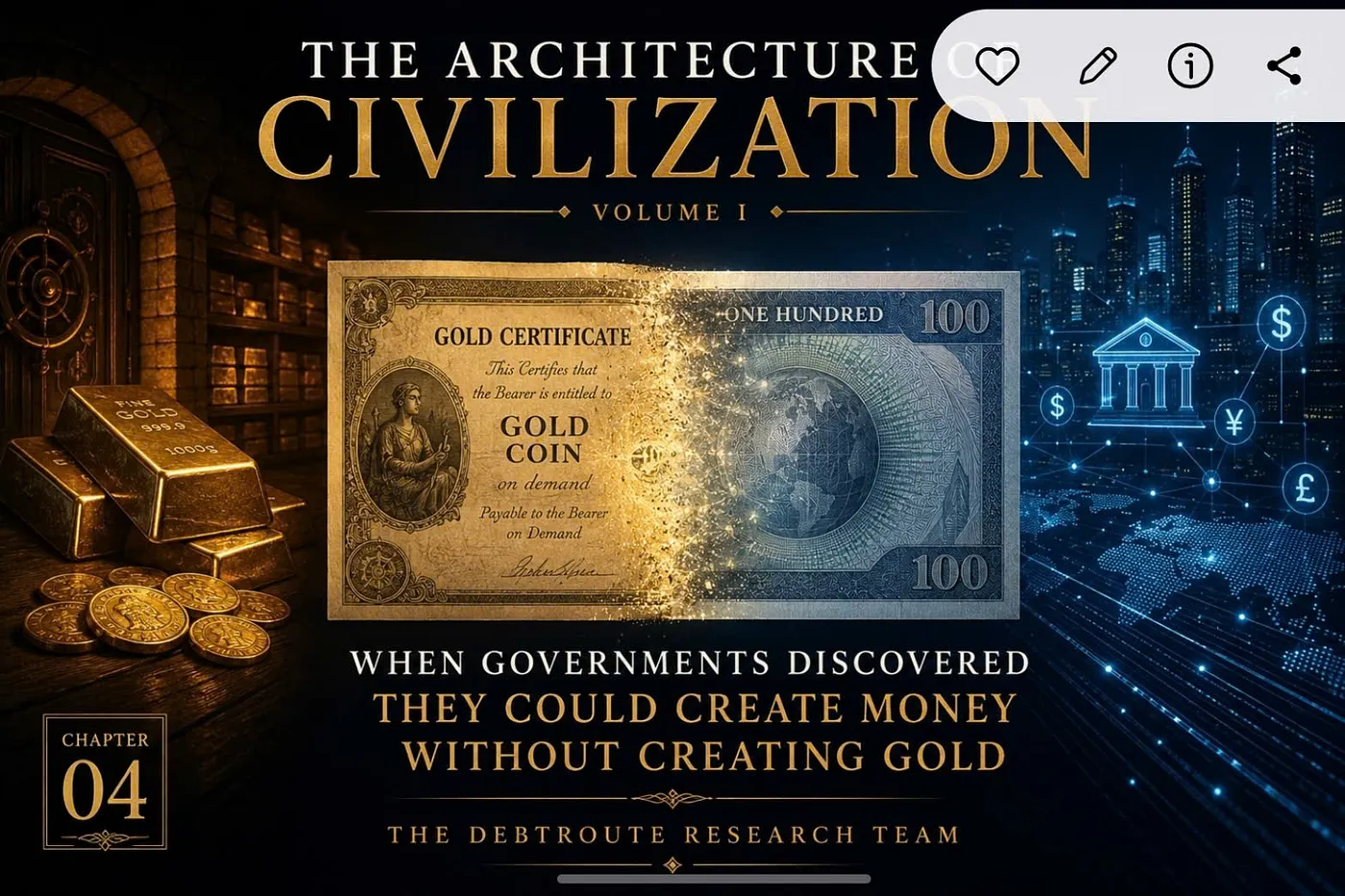
“The greatest financial revolution in history did not happen when gold was discovered. It happened when governments realized they no longer needed it.”
Introduction
For centuries, paper money was never supposed to replace gold.
It merely represented it.
A banknote was a promise.
Behind every note was an amount of precious metal waiting in a vault.
The system worked because paper remained tied to something tangible.
Until governments discovered something extraordinary.
A nation could issue more paper than the gold it possessed.
As long as people continued believing in the currency…
the system could keep functioning.
That realization quietly transformed the global economy.
Money was no longer backed primarily by gold.
It became backed by confidence in governments, institutions, and the future.
Civilization had entered the age of fiat money.
From Promise to Policy
Under the gold standard, governments faced a hard constraint.
If a country wanted more money in circulation, it generally needed more gold.
That limited rapid monetary expansion.
It also limited how easily governments could finance wars, economic crises, or large public projects.
Paper money changed that equation.
Once currencies became increasingly detached from physical gold, governments gained greater flexibility over the money supply.
Supporters argued this flexibility helped economies respond to recessions and financial shocks.
Critics warned it also increased the risk of inflation, excessive debt, and currency depreciation if managed poorly.
The debate continues today.
The New Foundation of Money
Modern currencies derive value from more than printed paper.
Their strength depends on a broader framework:
- The credibility of governments.
- Independent central banks.
- Productive economies.
- Stable legal systems.
- Public confidence.
Money became an institutional promise rather than a metallic claim.
This shift allowed unprecedented economic growth.
It also made trust more important than ever.
The Double-Edged Sword
The ability to expand the money supply can stabilize economies during crises.
History shows that central banks have used monetary policy to support financial systems in periods of stress.
At the same time, excessive monetary expansion has, in some countries and periods, contributed to high inflation or loss of confidence in the currency.
The same tool that can protect an economy…
can also weaken it if confidence erodes.
The Invisible Contract
Every modern currency rests on an unwritten agreement.
Citizens accept money because they believe others will continue accepting it tomorrow.
Businesses invest because they expect contracts to be honored.
Governments borrow because investors believe obligations will ultimately be repaid.
This collective expectation is one of civilization’s most valuable assets.
Without it, no monetary system — whether backed by gold or paper — can function for long.
What This Means for Your Money
Here’s my take: fiat money is a promise, and inflation is the slow leak in that promise. The Bureau of Labor Statistics reports that consumer prices rose 3.4% over the 12 months ending August 2026. A basket of groceries that cost $100 a year ago now costs about $103.40.
Now look at debt. The Federal Reserve’s G.19 report puts the average credit card APR, on accounts that pay interest, at 22.15% in Q2 2026. That’s more than six times the inflation rate. Inflation nibbles at your cash; card interest takes big bites. In my view, that’s why paying down high-interest debt comes before almost everything else.
Not sure which debt to tackle first? Compare the methods here: Debt Payoff Strategies: Avalanche, Snowball and More.
Closing Reflection
Gold did not disappear from history.
Many central banks still hold substantial gold reserves.
Investors often turn to gold during periods of uncertainty.
Yet daily economic life operates through something less tangible.
Confidence.
Modern civilization is built not only on laws or institutions, but on the shared belief that tomorrow’s promises will still matter.
Understanding money, therefore, is not only about economics.
It is about understanding trust itself.
Coming Next
Part Five
Why Most Wealth Exists Only as Numbers
“The greatest transformation in the history of money happened so quietly that most people never noticed it.”
Sources: U.S. Bureau of Labor Statistics, CPI News Release (Aug. 2026); Federal Reserve G.19 Consumer Credit. Educational content, not financial advice.
Part of The Architecture of Civilization, a free plain-English book on money, debt and trust. Follow DebtRoute on Facebook or join the DebtRoute Discord to get new chapters first. Educational content, not financial advice.