
The Architecture of Civilization · Part 3
How Paper Money Was Born: From Gold Receipts to the First Banks
The Day Humanity Began Trusting Paper More Than Gold
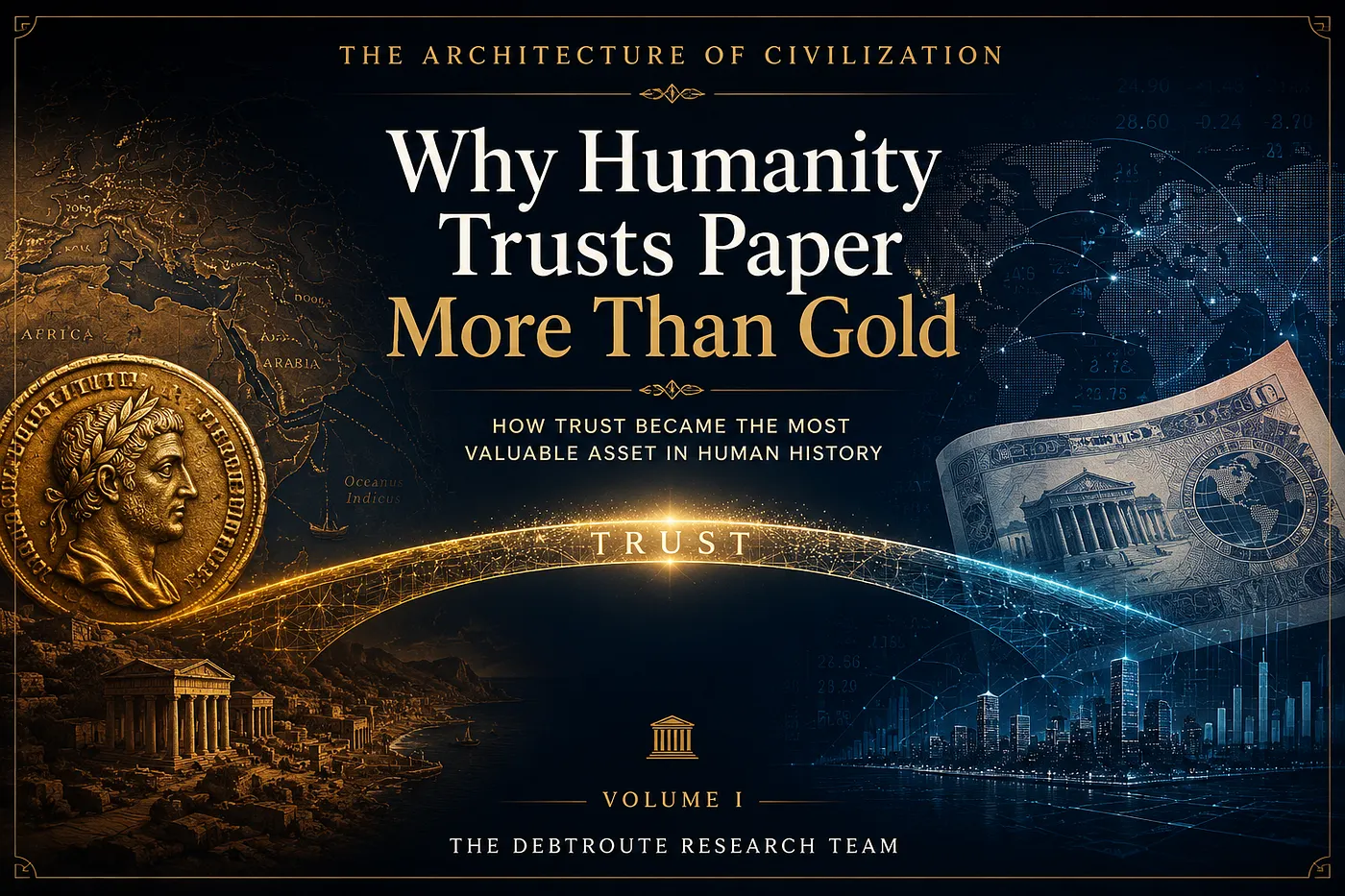
If gold had served humanity so well for thousands of years, why did we ever move away from it?
The answer was not because gold failed.
It was because civilization changed.
As trade expanded across continents, economies became larger, populations grew, and commerce accelerated. The physical movement of gold could no longer keep pace with the growing complexity of human exchange.
Merchants faced a new problem.
Transporting gold over long distances was expensive.
It was slow.
It attracted thieves.
And large transactions often required enormous quantities of metal.
The very asset that had once enabled trade was gradually becoming an obstacle to even greater trade.
Human civilization needed a better solution.
The First Step Toward Paper Money
The solution did not begin with governments.
It began with trust between private individuals.
Goldsmiths offered secure vaults where merchants could store their gold.
In return, they issued handwritten receipts proving ownership.
At first, these receipts were simple claims.
Whoever held the receipt could return to the vault and redeem the exact amount of gold deposited.
Something remarkable soon happened.
Merchants discovered that exchanging the receipt was easier than withdrawing the gold itself.
Instead of carrying heavy coins across cities, they simply transferred the paper receipt.
The paper represented the gold.
Eventually, people stopped asking for the gold.
They trusted the paper.
Without realizing it, civilization had taken its first step toward modern money.
Trust Changed Everything
Notice what actually happened.
Gold never disappeared.
It remained safely inside the vault.
What changed was human behavior.
People realized they trusted the promise as much as the metal itself.
The receipt had become more convenient than the asset it represented.
This moment marked one of the greatest transformations in economic history.
Money was no longer defined by what it was made of.
Money became defined by what people believed it could represent.
Trust had quietly become the foundation of finance.
From Receipts to Banks
As trade continued to expand, institutions recognized an opportunity.
If depositors rarely withdrew all their gold at the same time, perhaps some of that gold could be lent to others.
This practice eventually evolved into banking.
Banks became intermediaries between savers and borrowers.
Instead of idle gold sitting in vaults, capital began circulating through the economy.
Businesses expanded.
Infrastructure was built.
Innovation accelerated.
Economic growth increasingly depended not only on accumulated wealth but also on the efficient allocation of capital.
Modern banking was born from a simple observation:
Not every promise would be redeemed at the same moment.
The Fragile Nature of Confidence
Yet this new system carried an invisible risk.
Its strength depended entirely on confidence.
As long as people believed their deposits were safe, the system functioned smoothly.
But if everyone demanded their gold simultaneously, no institution could satisfy every claim immediately.
History would later call these events bank runs.
The problem was not always the amount of gold.
The problem was the sudden collapse of trust.
Once confidence disappeared, even healthy financial institutions could fail.
This lesson would echo throughout every major banking crisis that followed.
A Civilization Built on Invisible Agreements
Looking back, the transition from gold to paper was not merely a technological innovation.
It was a psychological revolution.
Humanity discovered that shared belief could move economies more efficiently than precious metals alone.
Gold still possessed value.
But trust had become even more valuable.
Every banknote represented an invisible agreement.
Every financial transaction reflected a collective belief that others would continue accepting the same promise tomorrow.
That belief remains the invisible architecture supporting the modern financial system today.
What This Means for Your Money
Here’s my take: those early paper receipts worked only because people believed they could get their gold back. Your bank account runs on the same belief. The difference today is that you don’t have to rely on faith alone.
The FDIC insures bank deposits up to $250,000 per depositor, per insured bank, for each account ownership category. Credit unions have similar coverage through the NCUA. So check two things this week: is your money in an insured institution, and do you keep a small cash cushion there, so one surprise bill doesn’t land on a credit card?
If every paycheck is gone before the next one arrives, start with this plan: How to Stop Living Paycheck to Paycheck.
Coming Next
Part Four: When Governments Became the Guardians of Trust
How states transformed private promises into national currencies — and forever changed the relationship between money and power.
Sources: FDIC, Understanding Deposit Insurance; NCUA, Share Insurance Coverage. Educational content, not financial advice.
Part of The Architecture of Civilization, a free plain-English book on money, debt and trust. Follow DebtRoute on Facebook or join the DebtRoute Discord to get new chapters first. Educational content, not financial advice.