
The Architecture of National Power · Part 3
The Labor Trap
Cheap labor: launchpad or ceiling?
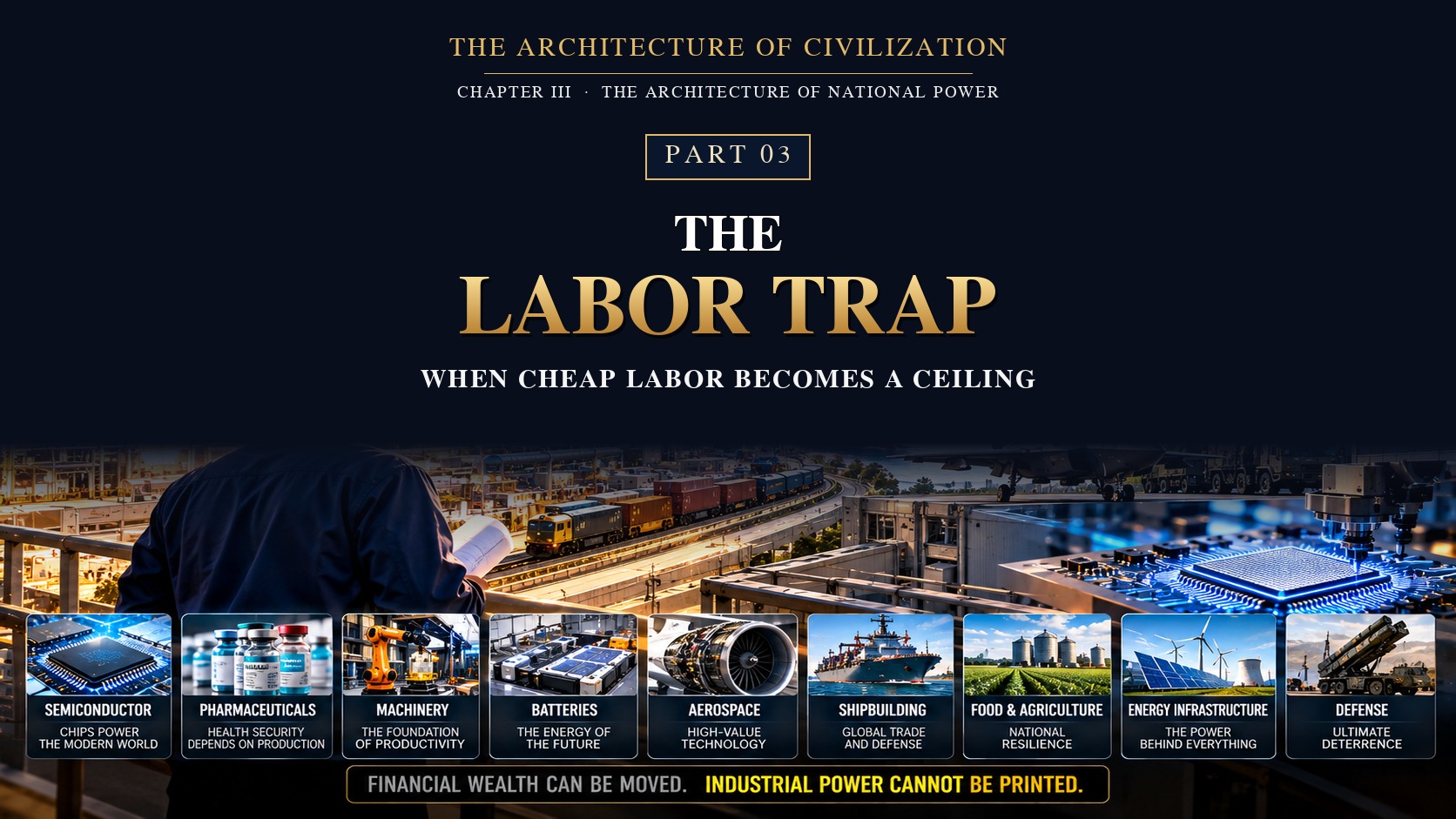
One of the most powerful development strategies in modern history is also one of the easiest to get trapped inside:
Cheap labor.
A young workforce attracts foreign companies. Factories appear. Jobs appear. Roads and ports improve. Exports rise. GDP rises.
It can look like a miracle. Often it is.
The danger begins when the beginning becomes the entire strategy.
THE HIDDEN QUESTION
What happens when another country becomes cheaper?
If the main advantage is labor cost, capital can move. Orders can move. Factories can move. The country that looked like the future becomes one stop in a global search for lower costs.
As wages rise, the advantage narrows. Cheaper producers press from below. More advanced producers hold the top.
The country gets squeezed in the middle — more expensive without becoming much more capable.
Not a collapse. Something slower and more dangerous: a long stall.
FROM “CHEAP” TO “IRREPLACEABLE”
The first stage is: “We are cheap.”
The second must become: “We are productive.”
Eventually: “We are difficult to replace.”
Foreign investment can accelerate that climb. It can bring capital, machinery, management, quality standards, supply-chain relationships and access to global customers.
Or it can remain an enclave.
The factory arrives. Workers assemble. Profits leave. Design, patents, brands and key decisions stay elsewhere. Local suppliers stay weak.
So the real test is not the investment total or the number of jobs in the headline.
It is what remains after the investor arrives:
Skills? Engineering? R&D? Local suppliers? Brands? Design? Capital?
If yes, foreign capital becomes a classroom.
If not, a country can stay near the bottom of the value chain for decades.
NO UNIVERSAL FORMULA
Japan, South Korea, Taiwan and China each climbed under different historical and political conditions. Their paths should not be reduced to one recipe. But they share one lesson: upgrading demands persistent investment, learning, competition and institutions that can absorb knowledge — not just host factories.
Which raises a controversial question:
Are global supply chains primarily a mechanism for exploitation — or one of the fastest mechanisms ever built for transferring capital and knowledge across borders?
Maybe both. It depends on who is learning faster.
And there is a harder question still: if a country’s main advantage is that its workers are cheap, what happens when workers somewhere else become cheaper — or machines become cheaper than workers everywhere?
The real trap is not cheap labor itself.
It is dependency.
And the way out is not more labor. It is what stands behind each worker.
What This Means for Your Money
Countries get trapped when they depend on one advantage. Households do too, when everything depends on one income source. A second, smaller income stream is your own version of moving up the ladder.
One step this week: read our ways to earn extra income to pay off debt.
This is Part 3 of The Architecture of National Power, Chapter III of DebtRoute’s free book The Architecture of Civilization. A new part publishes every day. Follow DebtRoute on Facebook or join the DebtRoute Discord to get the next part. Educational content, not financial advice. Images are illustrative. Hypotheses are labeled as such.