
The Architecture of Money · Part 8
Bitcoin, Stablecoins and Power: Is Crypto Becoming a Dollar Strategy?
The policy facts, and one hypothesis: crypto may carry the dollar further, not replace it.
I want to say one thing immediately: I do not think we should look at crypto through only two extremes.
“Crypto is the future.”
Or: “Crypto is just a bubble.”
The more interesting question is:
What happens if a major power brings crypto inside its financial system?
That is where the policies of President Donald Trump’s administration become interesting to study.
1. From “Crypto Capital” to Policy
On January 23, 2025, President Trump signed an executive order on strengthening American leadership in digital financial technology.
The order created the President’s Working Group on Digital Asset Markets and directed it to propose a federal regulatory framework for digital assets. Among its stated aims: promoting the sovereignty of the U.S. dollar, including through the development of lawful, dollar-backed stablecoins worldwide. It also prohibited agencies from establishing a U.S. central bank digital currency.
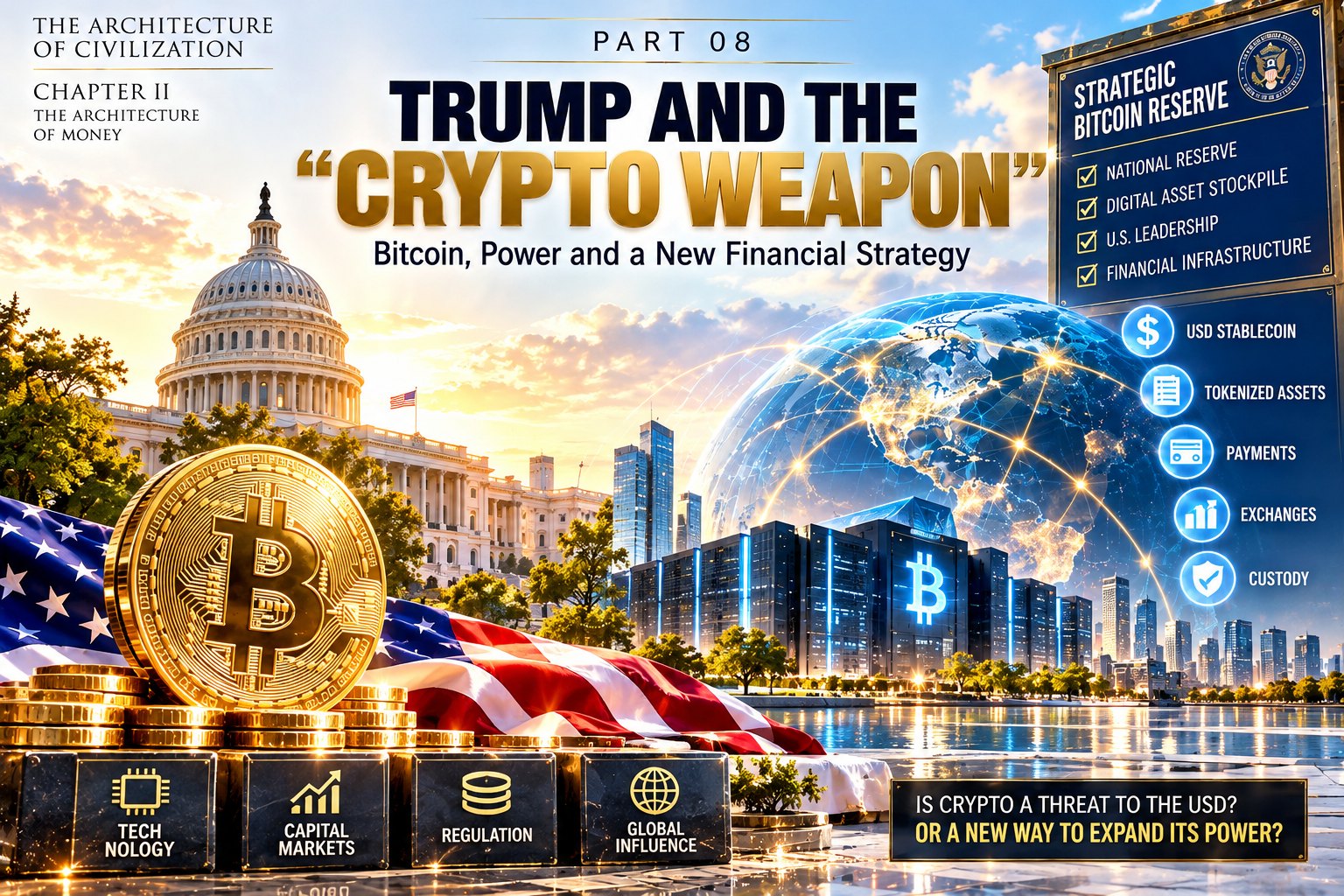
On March 6, 2025, a second order established the Strategic Bitcoin Reserve and the U.S. Digital Asset Stockpile.
On July 18, 2025, the GENIUS Act became law, creating a federal framework for payment stablecoins, which must be backed by reserves such as U.S. dollars and short-term Treasury bills.
This was no longer simply a crypto company. It was national policy.
2. But Why? A Hypothesis
Here I want to offer a personal hypothesis, not an established fact.
One possibility: the United States may not want crypto to replace the dollar.
The opposite may be true. It may want to bring crypto into a financial system in which the dollar stays at the center.
Look at stablecoins. If the largest stablecoins are backed by dollars or dollar-denominated assets, crypto grows, and the dollar is used even more.
If exchanges, custody, payments, tokenized assets and on-chain markets grow inside the U.S. system, the U.S. does not necessarily lose influence. It may move that influence from the old financial plumbing into new digital infrastructure.
Again: this is my hypothesis. It is not an official statement of the administration’s motives.
3. The Strategic Bitcoin Reserve
This is the particularly interesting part.
The March 2025 order capitalizes the reserve with bitcoin the government already holds, coins “finally forfeited” in criminal or civil proceedings. It also says any strategy to acquire more bitcoin must be “budget neutral” and “not impose incremental costs on United States taxpayers.”
I do not need to say “bitcoin will rule the world.”
I only need to ask:
Why would a government begin treating an asset once seen as outside the system as a strategic asset?
That question alone is worth thinking about.
4. What Is the Real “Weapon”?
The way I see it, the weapon may not be bitcoin at all.
The weapon may be infrastructure.
Whoever shapes:
- exchanges
- custody
- stablecoins
- payments
- tokenized securities
- regulation
- technology
- liquidity
may hold enormous influence over the next financial system.
And if much of that infrastructure runs on dollars, crypto may not kill the dollar.
It may extend the dollar’s reach into a new digital world.
That is the hypothesis I think is worth watching.
What This Means for Your Money
Policy can make crypto more mainstream. It does not make it safe in the way a bank deposit is.
The FDIC lists crypto assets among the products that deposit insurance does not cover. Stablecoins regulated under the GENIUS Act must hold reserves, but they are still not FDIC-insured bank deposits.
One step this week: if you hold crypto or stablecoins, check that money you need for rent, bills or debt payments is in an FDIC-insured account, not on an exchange. And never borrow to buy crypto; high-interest debt is a guaranteed loss to pay off first, see our debt payoff calculator.
Sources: The White House, Executive Order “Strengthening American Leadership in Digital Financial Technology” (Jan. 23, 2025); The White House, Executive Order establishing the Strategic Bitcoin Reserve and U.S. Digital Asset Stockpile (Mar. 6, 2025); Congress.gov, S.1582, GENIUS Act (signed July 18, 2025); FDIC, “Understanding Deposit Insurance”.
This is Part 8 of The Architecture of Money, a DebtRoute series on how money really works. Next: BRICS and the Dollar. Follow DebtRoute on Facebook or join the DebtRoute Discord to get the next part. Educational content, not financial advice. Images are illustrative. This article describes public policy documents and offers a clearly labeled hypothesis; it is not political commentary or investment advice.