
The Architecture of Money · Part 1
How the Fed Works: The 4 Numbers Behind Your Credit Card Rate
12 banks, 12 votes, 7 governors, 9 directors, and the path from their decisions to your credit card rate.
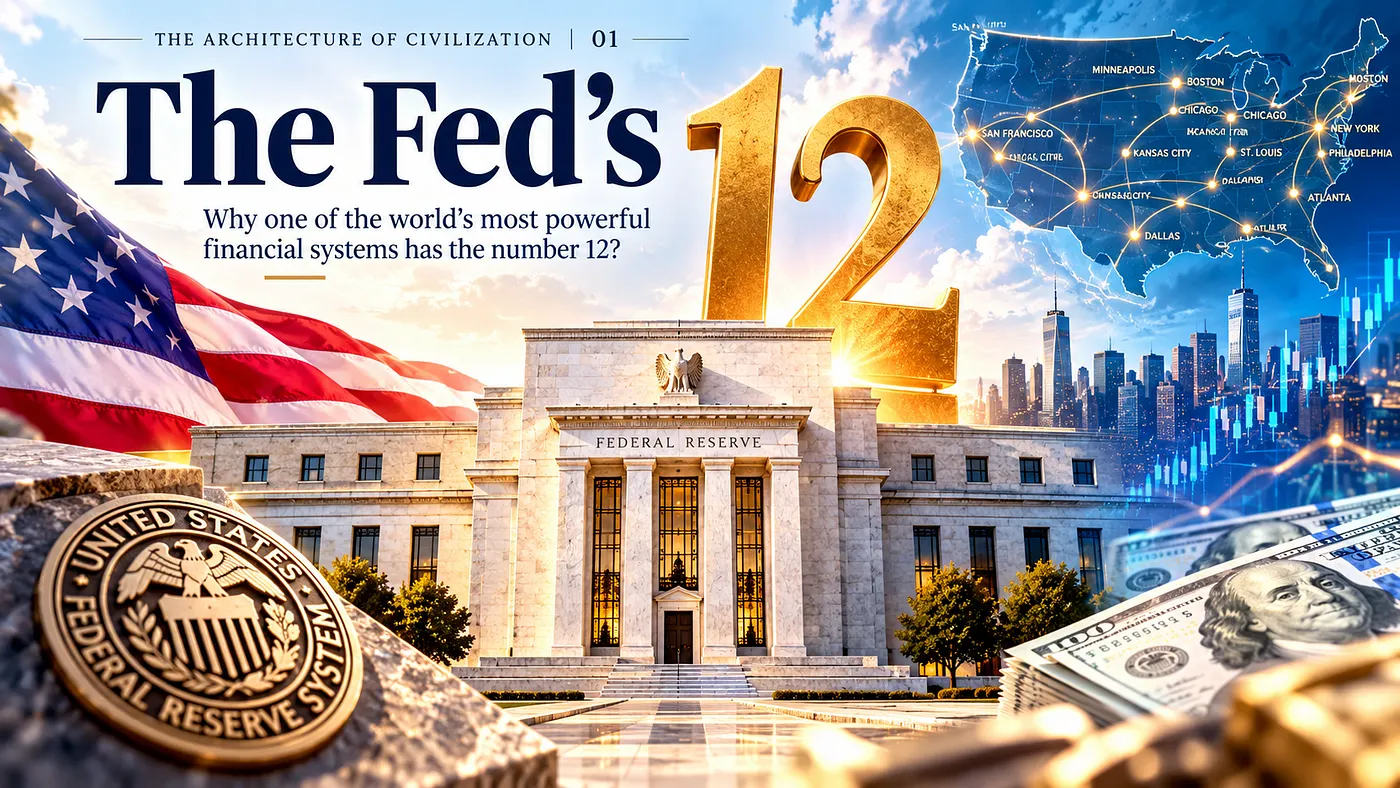
There is something very strange.
An ordinary worker may not know what the FOMC is.
They may not know how many branches the Federal Reserve has.
They may not know who votes to change interest rates.
They may not know that a decision made in Washington can affect their mortgage, credit-card debt, the USD exchange rate, or the price of goods they buy every day.
But they still have to live with those decisions.
That is what I find interesting.
We usually see money as something very simple:
I work → I get paid → I spend money.
But behind that piece of money is a gigantic system.
And at the center of the USD system is a name almost everyone has heard:
The Federal Reserve — the FED.
1. The FED Was Not There From the Beginning
The United States did not always have a modern central bank.
Historically, the United States had the First Bank of the United States, which operated from 1791 to 1811.
Then came the Second Bank of the United States, from 1816 to 1836.
But the United States continued to experience banking crises.
One of the most important was the Panic of 1907.
The U.S. financial system experienced a serious crisis and ultimately relied heavily on the ability of private institutions to mobilize liquidity.
A famous financial figure of that era — J.P. Morgan — played an important role in organizing support for the banking system.
That raised a very simple question:
How large does an economy have to become before it can no longer depend on a few wealthy individuals to rescue the financial system every time a crisis occurs?
The eventual answer was:
The FED.
On December 23, 1913, President Woodrow Wilson signed the Federal Reserve Act.
A new monetary structure was created.
2. The First Number: 12
This is the number I want people to remember.
12.
The FED has 12 Federal Reserve Banks.
Not one.
Not five.
Not ten.
12.
The Reserve Banks are distributed across different regions of the United States.
But if we look only at the number 12, we still have not reached the interesting part.
Because above this system there is also:
The Board of Governors.
And alongside it:
The FOMC — the Federal Open Market Committee.
That is where the story becomes interesting.
3. The Second Number: 12 People
The FOMC has 12 voting members.
They include:
- 7 members of the Board of Governors
- The President of the Federal Reserve Bank of New York
- 4 other Reserve Bank presidents, on a rotating basis
The FOMC normally has 8 scheduled policy meetings each year.
Think about that.
There are hundreds of millions of people in the U.S. economy.
Millions of businesses.
Thousands of banks.
Billions of transactions.
Yet a very important part of monetary policy is determined through a voting mechanism involving 12 people.
I am not saying that these 12 people “control the world.”
No.
But I want readers to understand something:
Monetary power does not sit where we usually look for it.
4. The Third Number: 7
The Board of Governors has 7 members.
Governors are nominated by the President and confirmed by the Senate.
Their terms are 14 years, with terms staggered over time.
Fourteen years.
That is a very long period compared with a normal political cycle.
And that is part of the design:
monetary policy is not supposed to change completely with every election cycle.
That is one reason the FED is generally described as an independent central bank.
But independent does not mean “unaccountable.”
The Board of Governors is a federal agency and is accountable to Congress.
5. The Fourth Number: 9
Each Federal Reserve Bank has a board of 9 directors, divided into three classes: A, B, and C.
It is a very unusual structure involving banking, business, and public representation.
And this is exactly why I think it is too simplistic to say:
“The FED is a private bank.”
Or:
“The FED is completely a government institution.”
Both descriptions are too simple.
The Federal Reserve System has public and private characteristics intertwined within its structure.
The FED itself explains that the system is not a corporation “owned” by a group of wealthy people in the ordinary sense.
And this is where I want readers to think for themselves.
What is a monetary system with such a complicated structure actually designed to do?
6. Hawks and Doves
In the financial world, you will often hear two words:
Hawk and Dove.
“Hawk” is generally used to describe people who tend to prioritize controlling inflation and maintaining tighter monetary policy.
“Dove” is generally used for people who place greater emphasis on growth and employment and may favor easier policy under certain circumstances.
But these are not official titles.
They are market descriptions of policy views.
And markets have a very interesting habit:
markets are always trying to predict what the people with power will do next.
7. And This Is Where the Machine Begins
The FED does not simply “print money.”
That is an overly simple explanation.
When the FED changes interest-rate policy, the effects can move through:
short-term interest rates → long-term interest rates → credit → exchange rates → financial conditions → consumption → investment → employment → prices.
The Federal Reserve itself describes this transmission mechanism.
So when someone says:
“The FED raised interest rates.”
Do not think only:
“Bank interest rates went up.”
Think:
One gear has just been turned inside an entire system.
What This Means for Your Debt
Here is where the 12 votes reach your wallet. Most credit cards have a variable APR, which the CFPB says changes with an index interest rate, such as the prime rate. When the FOMC moves its target rate, the prime rate usually follows, and so does your card rate.
In the second quarter of 2026, the average APR on credit card accounts that were charged interest was 22.15%, according to the Federal Reserve’s G.19 report.
If you carry a balance, start with two free lessons: how credit card interest works, and the five ways out of debt.
DebtRoute Perspective
I do not think the most frightening thing is the FED.
I think the more important thing is this:
We live in a system where most people use money every day but barely understand the architecture behind it.
And that is exactly why I started this series.
Because if money is no longer simply gold…
then the next question is:
What actually is money?
Sources: Board of Governors of the Federal Reserve System (Structure of the Federal Reserve System; Federal Open Market Committee; Reserve Bank directors; Monetary policy: what are its goals and how does it work; G.19 Consumer Credit); Federal Reserve History (Panic of 1907; Federal Reserve Act signed); Consumer Financial Protection Bureau.
This is Part 1 of The Architecture of Money. New parts are added as they are published. Follow DebtRoute on Facebook or join the DebtRoute Discord to get new chapters first. Educational content, not financial advice.