
The Architecture of Civilization · Parts 1 & 2
Why We Trust Paper Money More Than Gold
Understanding the Invisible Foundation of Modern Civilization
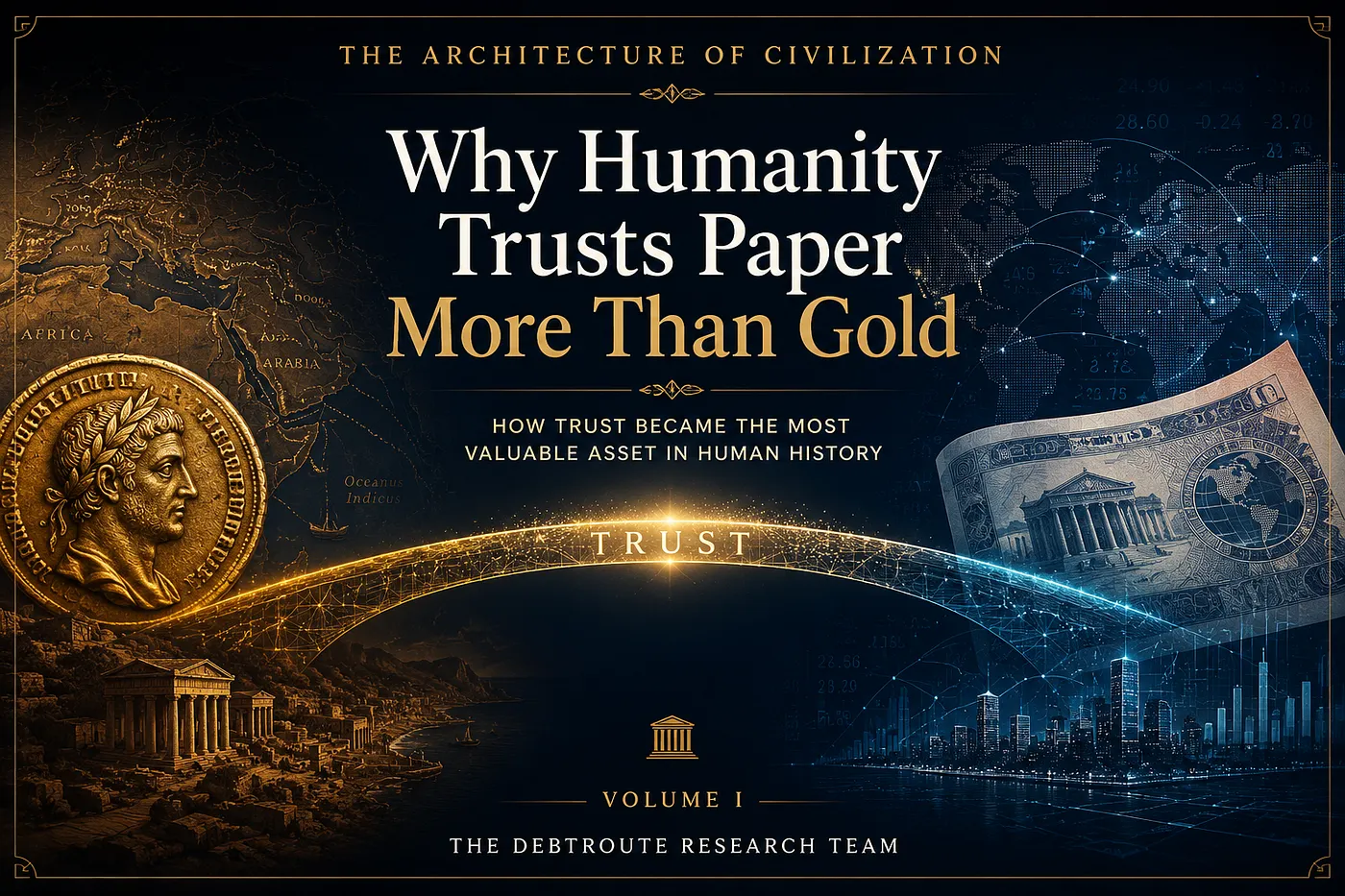
“Every civilization is built on something invisible. Before there were skyscrapers, stock markets, or global trade, there was a simple idea powerful enough to connect millions of strangers: trust.”
Introduction
Imagine walking into a grocery store with a one-hundred-dollar bill.
Within minutes, you exchange that piece of paper for food, water, medicine, or perhaps the ingredients that will feed your family for a week.
No one asks whether the paper itself is valuable.
No one examines the cotton fibers or calculates the cost of the ink.
Everyone simply accepts it.
Now imagine traveling back 700 years with that same banknote.
A medieval merchant would probably reject it.
Not because he was irrational.
But because your paper carried no meaning inside his world.
This raises one of the most fascinating questions in economic history:
Why does modern civilization trust paper more than gold?
For thousands of years, gold represented permanence.
It survived wars.
It crossed empires.
It outlived kings.
Yet today, the overwhelming majority of global commerce happens without gold ever changing hands.
Instead, we rely on paper money — and increasingly, on digital numbers stored inside computers.
How did humanity make that leap?
Was it simply because governments declared it so?
Because militaries enforced it?
Or is there a deeper force that has always driven every monetary system throughout history?
This article is not about predicting the next financial crisis.
It is not about whether gold will rise or whether the U.S. dollar will fall.
Instead, it asks a more fundamental question:
What is money, really?
Because before we can understand inflation, debt, central banks, cryptocurrencies, or reserve currencies, we must first understand the invisible force that makes all of them possible.
That force is trust.
Part One
Before Money, There Was Cooperation
Money did not appear because ancient people loved gold.
It appeared because civilization became too complex for simple barter.
Imagine a farmer growing wheat.
He needs a blacksmith to repair his tools.
The blacksmith needs shoes.
The shoemaker wants meat.
The butcher needs salt.
Each person owns something valuable.
Yet trade becomes painfully inefficient because every exchange depends on finding someone who wants exactly what you have while offering exactly what you need.
Economists call this the double coincidence of wants.
It is one of history’s greatest obstacles to economic growth.
Civilizations needed something better.
Not merely a commodity.
But a common language of value.
Money became that language.
Its first purpose was never wealth.
Its first purpose was coordination.
Money allowed complete strangers to cooperate without knowing each other.
That single innovation transformed villages into cities.
Cities into kingdoms.
Kingdoms into civilizations.
Part Two
Gold Was Never the Beginning
Many people believe that gold created money.
History suggests the opposite.
Long before gold dominated international trade, humanity experimented with countless forms of money.
Different societies used:
- Cattle
- Salt
- Cowrie shells
- Copper
- Silver
- Grain
- Cloth
- Large stone disks
- Bronze tools
Each served the same purpose.
They represented value because communities agreed they did.
Gold eventually became dominant because it possessed remarkable characteristics.
It is scarce.
Durable.
Portable.
Difficult to counterfeit.
Easy to divide.
Beautiful.
These qualities made gold an exceptional store of value.
But they did not automatically make it money.
Gold became money only after societies trusted it enough to perform that role.
This distinction is crucial.
Gold did not create trust.
Trust transformed gold into money.
And that insight changes the way we understand every monetary system that followed.
What This Means for Your Money
Here’s my take: the rule that turned gold into money still runs your financial life today. Trust is the real currency. A lender can’t see you, so it looks at your track record instead.
That track record is your credit score. In the FICO model, payment history makes up about 35% of your score, more than any other factor. One late payment can follow you for years. Paying on time, every month, is how you earn the system’s trust.
If your score needs work, start here: How to Improve Your Credit Score, step by step.
Coming Next
Part Three — The Day Humanity Began Trusting Paper More Than Gold.
Sources: myFICO, What’s in Your Credit Score. Educational content, not financial advice.
Part of The Architecture of Civilization, a free plain-English book on money, debt and trust. Follow DebtRoute on Facebook or join the DebtRoute Discord to get new chapters first. Educational content, not financial advice.